 ClimaClue
Fayzabad weather by month and climate
Badakhshan · Afghanistan
Average temperature, rain and snow, sunshine and more for every month in Fayzabad, from modelled 1981–2010 averages for the town itself (about 3 × 3 km around its centre).
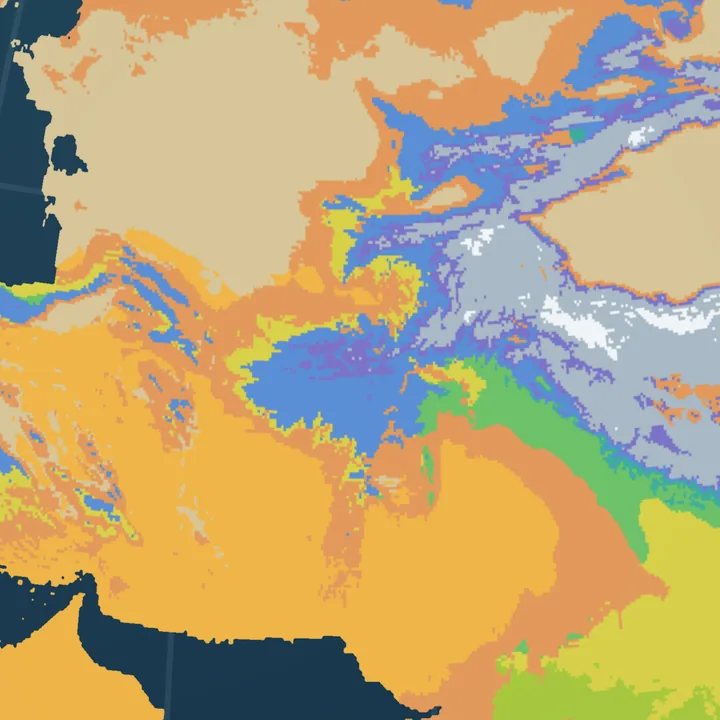
Cold semi-arid · BSkOpen Fayzabad on the globe ›Fayzabad is warmest in July, with 31.1 °C (88 °F) days and 14.8 °C nights, and coolest in January, with 2.5 °C (37 °F) days and -7.2 °C nights. Most rain falls around April (70 mm); August is driest (3 mm).
- Day to day
- ±3.9 °Ca typical day’s swing from its month’s normal; most changeable in December (±5.5 °C)
- Year to year
- ±2.7 °Chow much a month’s average varies between years, most in November; least ±1.1 °C in September
- Best months
- May, Jun, Jul, Aug, Sepmild and not too wet · where else is warm in May
- Year average11.4 °C52 °F
- Warmest · July23.0 °C73 °F
- Coolest · January-2.4 °C28 °F
- Rain and snow a year349 mm13.7 in
- Sunshine a year2,468 habout 1961–1990
Climate type: Cold semi-arid (Köppen BSk) · about this type
Dry grassland climate with cold winters.
Borderline: rainfall is close to the dry-climate threshold.
Fayzabad at a glance
Among the 57 towns ClimaClue covers in Afghanistan, Fayzabad is the 3rd least sunny (about 2,468 hours of sunshine a year). Compared with Bahārak, the nearest covered town with different numbers (32 km away), Fayzabad is 3.1 °C warmer in July and 0.6 °C warmer in January, with 12 mm more precipitation a year. Its warmest month, July (23.0 °C), averages 25.3 °C more than its coolest, January (-2.4 °C). Average night lows are below 0 °C (32 °F) in January, February, November and December. The area lies about 1,368 km from the sea (deep inland).
Station check: no NOAA GHCN-Daily station with 1981–2010 averages lies within 25 km of Fayzabad, so these modelled values have not been compared with a nearby station.
Temperature and precipitation by month in Fayzabad
Charts: ClimaClue area averages, CHELSA V2.1, 1981–2010. Hover or tap a point or bar for its value; every number is in the table below.
| Month | Average °C | Day high °C | Night low °C | Precipitation mm |
|---|---|---|---|---|
| January | -2.428 °F | 2.537 °F | -7.219 °F | 351.4 in |
| February | 0.132 °F | 4.640 °F | -4.424 °F | 441.7 in |
| March | 5.742 °F | 10.851 °F | 0.633 °F | 572.2 in |
| April | 11.753 °F | 17.564 °F | 5.943 °F | 702.8 in |
| May | 17.163 °F | 23.674 °F | 10.651 °F | 491.9 in |
| June | 20.769 °F | 28.483 °F | 12.955 °F | 130.5 in |
| July | 23.073 °F | 31.188 °F | 14.859 °F | 60.2 in |
| August | 22.673 °F | 30.988 °F | 14.258 °F | 30.1 in |
| September | 18.966 °F | 27.582 °F | 10.351 °F | 30.1 in |
| October | 12.855 °F | 20.369 °F | 5.442 °F | 180.7 in |
| November | 5.842 °F | 12.054 °F | -0.431 °F | 240.9 in |
| December | -0.132 °F | 4.841 °F | -5.123 °F | 271.1 in |
| Year | 11.452 °F | 17.864 °F | 4.841 °F | 34913.7 in |
Average: monthly mean air temperature, day and night together. Day high and night low: the month's average daily maximum and minimum (the CHELSA average plus and minus half the day–night range of CRU CL 2.0), not the hottest or coldest days. Precipitation: monthly total of rain and snow as water.
Sunshine, wind and humidity in Fayzabad
| Month | Sunshine hours | Wind m/s | Humidity % | Dew point °C | Fresh snow cm |
|---|---|---|---|---|---|
| January | 115 | 1.32.9 mph | 44 | -13.97 °F | 3413.3 in |
| February | 111 | 1.22.7 mph | 45 | -11.212 °F | 3614.0 in |
| March | 147 | 1.12.5 mph | 48 | -5.422 °F | 3.41.3 in |
| April | 186 | 1.12.5 mph | 49 | 0.132 °F | 0 |
| May | 252 | 1.02.2 mph | 51 | 5.742 °F | 0 |
| June | 304 | 1.12.5 mph | 51 | 8.447 °F | 0 |
| July | 312 | 1.12.5 mph | 47 | 9.249 °F | 0 |
| August | 295 | 1.12.5 mph | 45 | 8.147 °F | 0 |
| September | 261 | 1.02.2 mph | 45 | 4.440 °F | 0 |
| October | 206 | 1.02.2 mph | 45 | -0.631 °F | 0 |
| November | 162 | 1.22.7 mph | 44 | -6.720 °F | 1.30.5 in |
| December | 118 | 1.43.1 mph | 44 | -11.711 °F | 228.7 in |
| Year | 2,468 | 1.12.5 mph | 46 | -1.130 °F | 9638.0 in |
Sunshine: estimated hours of bright sunshine (not daylight length or solar energy); the source gives a percentage of possible daylight, converted to hours with astronomical day length; yearly total. Wind: monthly mean speed about 10 m above the ground; gusts and direction are not shown. Humidity: relative humidity, calculated from the month’s average dew point and its average night low and day high (an estimate, not a measurement). Dew point: how much water vapour the air holds. Fresh snow: estimated depth from ERA5-Land snowfall (1 mm of water ≈ 1 cm of snow), adjusted to snowfall measured at nearby weather stations. Year row: totals for sunshine and snow, averages otherwise.
Best time to visit Fayzabad
For mild weather, the best months to visit Fayzabad are May, June, July, August and September.
- Mild (average temperature 15–25 °C / 59–77 °F and under 100 mm / 3.9 in of precipitation): May, June, July, August and September.
- Warmest (average temperature): July (23.0 °C), August (22.6 °C) and June (20.7 °C).
- Driest (least precipitation): August (3 mm), September (3 mm) and July (6 mm).
- Sunniest (hours of sunshine, about 1961–1990): July (312 h), June (304 h) and August (295 h).
Climate only: these rules use 1981–2010 monthly averages and do not consider crowds, prices, events or holidays; any one year can differ.
Fayzabad weather month by month
Average conditions for each month (1981–2010 monthly averages; sunshine about 1961–1990), not forecasts.
Fayzabad weather in January
Day high 2.5 °C (37 °F) · night low -7.2 °C (19 °F) · average -2.4 °C · precipitation 35 mm (1.4 in) · sunshine about 115 hours · humidity 44% · dew point -13.9 °C · fresh snow about 34 cm · snow on the ground about 6.2 cm deep.
Compared with December: 2.2 °C cooler, 8 mm more precipitation and 3 hours less sunshine.
Fayzabad weather in February
Day high 4.6 °C (40 °F) · night low -4.4 °C (24 °F) · average 0.1 °C · precipitation 44 mm (1.7 in) · sunshine about 111 hours · humidity 45% · dew point -11.2 °C · fresh snow about 36 cm · snow on the ground about 9.1 cm deep.
Compared with January: 2.4 °C warmer, 10 mm more precipitation and 3 hours less sunshine.
Fayzabad weather in March
Day high 10.8 °C (51 °F) · night low 0.6 °C (33 °F) · average 5.7 °C · precipitation 57 mm (2.2 in) · sunshine about 147 hours · humidity 48% · dew point -5.4 °C · fresh snow about 3.4 cm · snow on the ground about 8.7 cm deep.
Compared with February: 5.7 °C warmer, 13 mm more precipitation and 35 hours more sunshine.
Fayzabad weather in April
Day high 17.5 °C (64 °F) · night low 5.9 °C (43 °F) · average 11.7 °C · precipitation 70 mm (2.8 in) · sunshine about 186 hours · humidity 49% · dew point 0.1 °C · snow on the ground about 2.4 cm deep.
Compared with March: 6.0 °C warmer, 14 mm more precipitation and 40 hours more sunshine.
Fayzabad weather in May
Day high 23.6 °C (74 °F) · night low 10.6 °C (51 °F) · average 17.1 °C · precipitation 49 mm (1.9 in) · sunshine about 252 hours · humidity 51% · dew point 5.7 °C.
Compared with April: 5.4 °C warmer, 22 mm less precipitation and 65 hours more sunshine.
Fayzabad weather in June
Day high 28.4 °C (83 °F) · night low 12.9 °C (55 °F) · average 20.7 °C · precipitation 13 mm (0.5 in) · sunshine about 304 hours · humidity 51% · dew point 8.4 °C.
Compared with May: 3.5 °C warmer, 35 mm less precipitation and 52 hours more sunshine.
Fayzabad weather in July
Day high 31.1 °C (88 °F) · night low 14.8 °C (59 °F) · average 23.0 °C · precipitation 6 mm (0.2 in) · sunshine about 312 hours · humidity 47% · dew point 9.2 °C.
Compared with June: 2.3 °C warmer, 8 mm less precipitation and 8 hours more sunshine.
Fayzabad weather in August
Day high 30.9 °C (88 °F) · night low 14.2 °C (58 °F) · average 22.6 °C · precipitation 3 mm (0.1 in) · sunshine about 295 hours · humidity 45% · dew point 8.1 °C.
Compared with July: 0.4 °C cooler, 2 mm less precipitation and 17 hours less sunshine.
Fayzabad weather in September
Day high 27.5 °C (82 °F) · night low 10.3 °C (51 °F) · average 18.9 °C · precipitation 3 mm (0.1 in) · sunshine about 261 hours · humidity 45% · dew point 4.4 °C.
Compared with August: 3.6 °C cooler, about the same precipitation and 34 hours less sunshine.
Fayzabad weather in October
Day high 20.3 °C (69 °F) · night low 5.4 °C (42 °F) · average 12.8 °C · precipitation 18 mm (0.7 in) · sunshine about 206 hours · humidity 45% · dew point -0.6 °C.
Compared with September: 6.1 °C cooler, 14 mm more precipitation and 56 hours less sunshine.
Fayzabad weather in November
Day high 12.0 °C (54 °F) · night low -0.4 °C (31 °F) · average 5.8 °C · precipitation 24 mm (0.9 in) · sunshine about 162 hours · humidity 44% · dew point -6.7 °C · fresh snow about 1.3 cm.
Compared with October: 7.0 °C cooler, 6 mm more precipitation and 44 hours less sunshine.
Fayzabad weather in December
Day high 4.8 °C (41 °F) · night low -5.1 °C (23 °F) · average -0.1 °C · precipitation 27 mm (1.1 in) · sunshine about 118 hours · humidity 44% · dew point -11.7 °C · fresh snow about 22 cm · snow on the ground about 2.8 cm deep.
Compared with November: 5.9 °C cooler, 3 mm more precipitation and 44 hours less sunshine.
Why Fayzabad has this climate
Typical mechanisms for this climate type, plus facts measured for this place; not a verified local cause.
Dry air allows wide temperature swings; the seasons are often sharp. It sits on the edge of a desert: some rain-bearing systems reach it in one season, but not enough to make it humid. About 1,368 km from the sea: deep inland, where land heats and cools quickly, which usually makes seasons extreme. Here the coolest and warmest months differ by 25.3 °C. Within the 10 km area around it, monthly temperatures differ by up to 5.7 °C — typical where height changes quickly, as in hills or mountains.
Strongly seasonal: the wettest month gets more than five times the driest.
Fayzabad climate: questions and answers
- What is the warmest month in Fayzabad?
- July, with an average of 23.0 °C (73 °F), day highs around 31.1 °C (88 °F) and night lows around 14.8 °C (59 °F).
- What is the coldest month in Fayzabad?
- January, with an average of -2.4 °C (28 °F), day highs around 2.5 °C (37 °F) and night lows around -7.2 °C (19 °F).
- Which month gets the most rain in Fayzabad?
- April, with 70 mm (2.8 in) of precipitation (rain and snow as water), out of 349 mm (13.7 in) in a typical year.
- What is the driest month in Fayzabad?
- August, with 3 mm (0.1 in) of precipitation.
- What is the sunniest month in Fayzabad?
- July, with about 312 hours of bright sunshine (estimate for about 1961–1990).
- Does it snow in Fayzabad?
- Yes. About 96 cm (38.0 in) of fresh snow falls in a typical year (ERA5-Land snowfall at 1 mm of water ≈ 1 cm of snow, adjusted to nearby weather stations), most in February; snow lies on the ground (average depth 1 cm or more) in 5 months.
- When is the best time to visit Fayzabad?
- For mild weather (average temperature 15–25 °C / 59–77 °F and under 100 mm / 3.9 in of precipitation): May, June, July, August and September. Climate only, from 1981–2010 averages: crowds and prices are not considered.
- What type of climate does Fayzabad have?
- Cold semi-arid (Köppen BSk). Dry grassland climate with cold winters. Calculated from the town’s own 1981–2010 monthly averages.
Nearby towns in Afghanistan
- Bahārak32 km · Dsb · 337 mm a year9.3 °C
- Jurm36 km · Dsb · 328 mm a year9.2 °C
- Rustāq67 km · Dsa · 613 mm a year12.6 °C
- Ārt Khwājah98 km · BSk · 320 mm a year17.7 °C
- Dasht-e Qal‘ah101 km · BSk · 322 mm a year17.8 °C
- Taloqan102 km · BSk · 365 mm a year16.2 °C
Climate twins elsewhere
Towns in other countries whose monthly temperature and rain pattern is closest to Fayzabad’s (the measure used by ClimaClue’s Climate Twins game; seasons are lined up across hemispheres).
- Qūchān, IranBSk · months typically 0.8 °C apart
- Istaravshan, TajikistanDsa · months typically 0.9 °C apart
- Osh, KyrgyzstanDsa · months typically 1.1 °C apart
- Kayseri, TurkeyBSk · months typically 1.4 °C apart
- Boise, United StatesDsa · months typically 1.4 °C apart
About these numbers
Temperature, precipitation and wind: modelled monthly averages (climate normals) for Fayzabad itself, the average of the ~1 km source cells in the 3 × 3 km around its GeoNames location (37.117°N, 70.580°E). Day highs and night lows add the day–night range of the surrounding CRU cell (about 18 km), or on a few small islands the nearest weather station’s; where there is neither, they are not shown. Sunshine, dew point and snow come from coarser sources and describe the 0.1° area around it, about 8.9 × 11 km (ClimaClue area sq-468-2505), which is also what the globe shows when you click there; humidity is calculated from that dew point and the town’s own night lows and day highs. They are model estimates, not measurements at a weather station, and not forecasts. Sources: CHELSA V2.1, 1981–2010 (temperature, precipitation, wind); ERA5-Land, 1981–2010 (dew point and snow; snowfall matched to the area’s CHELSA climate; contains modified Copernicus Climate Change Service information); relative humidity calculated from the dew point and the night lows and day highs; CRU CL 2.0, about 1961–1990 (sunshine and the day–night range; a different period); GeoNames (name and population 44,421, CC BY 4.0); climate type by the Köppen–Geiger rules of Peel et al. (2007). How ClimaClue makes these numbers.