 ClimaClue
Mazār-e Sharīf weather in March
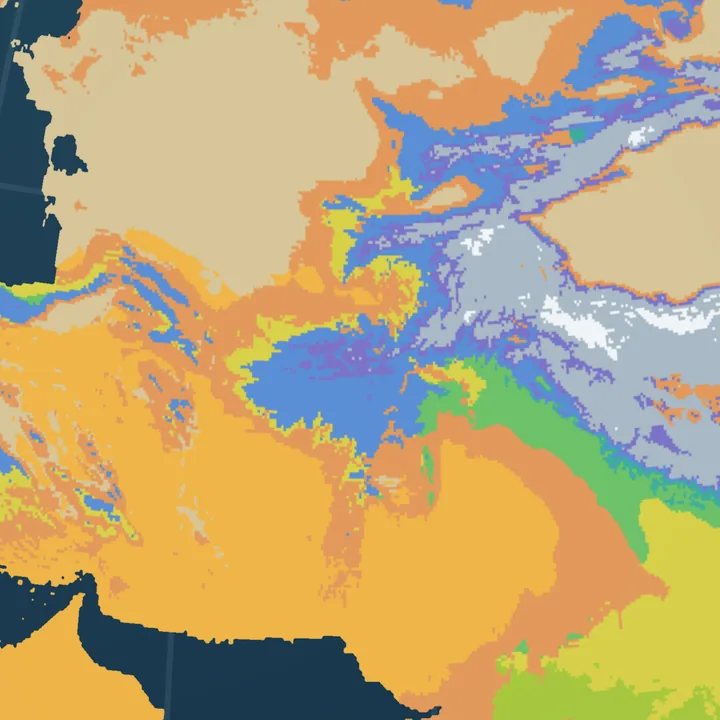
March · Balkh · Afghanistan
Average March weather in Mazār-e Sharīf: modelled 1981–2010 averages for the city itself (about 3 × 3 km around its centre) (climate normals, not a forecast).
Hot semi-arid · BShOpen Mazār-e Sharīf on the globe ›In March, Mazār-e Sharīf averages 17.9 °C (64 °F) days and 6.7 °C (44 °F) nights, with 51 mm (2.0 in) of rain over the month and about 168 hours of sunshine.
- Day to day
- ±4.8 °Chow far a typical March day strays from that average; about one day in twenty is twice as far
- Year to year
- ±2.1 °Cin two years out of three, March averages between 10.1 °C and 14.4 °C
- Good time to visit?
- Less somild months: Apr, May, Sep, Oct
Plan by month: where else is warm in March · warmest cities in the world in March · sunniest in March
- Day high17.9 °C64 °F
- Night low6.7 °C44 °F
- Average12.3 °C54 °F
- Precipitation51 mm2.0 in
- Sunshine168 habout 1961–1990
- Humidity68%relative
- Dew point5.4 °C42 °F
Station check: no NOAA GHCN-Daily station with 1981–2010 averages lies within 25 km of Mazār-e Sharīf, so these modelled values have not been compared with a nearby station.
How March compares in Mazār-e Sharīf
Charts: ClimaClue area averages, CHELSA V2.1, 1981–2010. Hover or tap a point or bar for its value; every number is in the table below.
March is the 5th coolest of the 12, the wettest month and the 4th least sunny of the 12 in Mazār-e Sharīf. Compared with February: 5.3 °C warmer, 15 mm more precipitation and 43 hours more sunshine. April is 6.7 °C warmer than March on average.
Mazār-e Sharīf among towns in Afghanistan in March
Of the 57 towns ClimaClue covers in Afghanistan, Mazār-e Sharīf ranks 16th warmest (average temperature), 43rd sunniest and 45th wettest in March.
Warmest: Khān Neshīn (19.3 °C) · coolest: Fayrōz Kōh (-2.1 °C) · sunniest: Khān Neshīn (238 h) · wettest: Nīlī (174 mm) · driest: Zaranj (14 mm).
What to pack for Mazār-e Sharīf in March
Going by the averages: a jacket or sweater, an extra layer for cooler evenings and a compact umbrella.
Rules used: day high under 10 °C (50 °F) → warm coat; 10–18 °C → jacket or sweater; 18–25 °C → light layers; 25 °C (77 °F) or more → light, breathable clothes; night low under 0 °C → hat and gloves; night low 10 °C or more below the day high → an extra layer for evenings; 100 mm or more of precipitation → rain jacket or umbrella; 50–100 mm → compact umbrella; 5 cm or more of fresh snow, or snow on the ground → waterproof boots; dew point 16 °C (61 °F) or more → breathable fabrics for humid air; 250 hours of sunshine or more → sunglasses. Averages only: check a forecast before you travel.
March in other big cities
| City | Day high | Night low | Precipitation | Sunshine |
|---|---|---|---|---|
| DushanbeTajikistan · 251 km away | 14.658 °F | 4.640 °F | 140 | 157 |
| KabulAfghanistan · 306 km away | 10.952 °F | -0.331 °F | 77 | 197 |
| SamarkandUzbekistan · 328 km away | 13.656 °F | 3.438 °F | 70 | 170 |
| AshgabatTurkmenistan · climate twin | 15.360 °F | 5.041 °F | 54 | 158 |
| QomIran · climate twin | 18.766 °F | 7.245 °F | 28 | 190 |
| Ar RaqqahSyria · climate twin | 19.767 °F | 7.546 °F | 30 | 220 |
Mazār-e Sharīf in March: questions and answers
- What is the weather like in Mazār-e Sharīf in March?
- In March, Mazār-e Sharīf averages a day high of 17.9 °C (64 °F) and a night low of 6.7 °C (44 °F), with 51 mm (2.0 in) of precipitation and about 168 hours of sunshine. These are 1981–2010 averages for the ~10 km area, not a forecast.
- Is March a good time to visit Mazār-e Sharīf?
- March is not one of Mazār-e Sharīf’s mild months; those are April, May, September and October, counting a month as mild with an average temperature 15–25 °C / 59–77 °F and under 100 mm / 3.9 in of precipitation. Climate only: crowds and prices are not considered.
- How much does it rain in Mazār-e Sharīf in March?
- 51 mm (2.0 in) of precipitation (rain and snow as water) on average, making March the wettest month of the year. The wettest month is March (51 mm), the driest August (0 mm).
- Does it snow in Mazār-e Sharīf in March?
- Little or none on average: ERA5-Land gives under 0.5 cm of fresh snow for March in this area (1981–2010).
- How many hours of sunshine does Mazār-e Sharīf get in March?
- About 168 hours of bright sunshine, the 4th least sunny of the 12 (estimate for about 1961–1990).
- What should I pack for Mazār-e Sharīf in March?
- Going by the averages: a jacket or sweater, an extra layer for cooler evenings and a compact umbrella. Check a forecast before you travel; these are long-term averages.
Jan Feb Mar Apr May Jun Jul Aug Sep Oct Nov Dec
Day high and night low are the month’s average daily maximum and minimum, not extremes. Sources: CHELSA V2.1, 1981–2010 (temperature, precipitation); ERA5-Land, 1981–2010 (dew point and snow; snowfall matched to the area’s CHELSA climate; contains modified Copernicus Climate Change Service information); humidity calculated from the dew point and temperature; CRU CL 2.0, about 1961–1990 (sunshine and the day–night range). More on the Mazār-e Sharīf climate page, Afghanistan and how the data is made.