 ClimaClue
Djelfa weather by month and climate
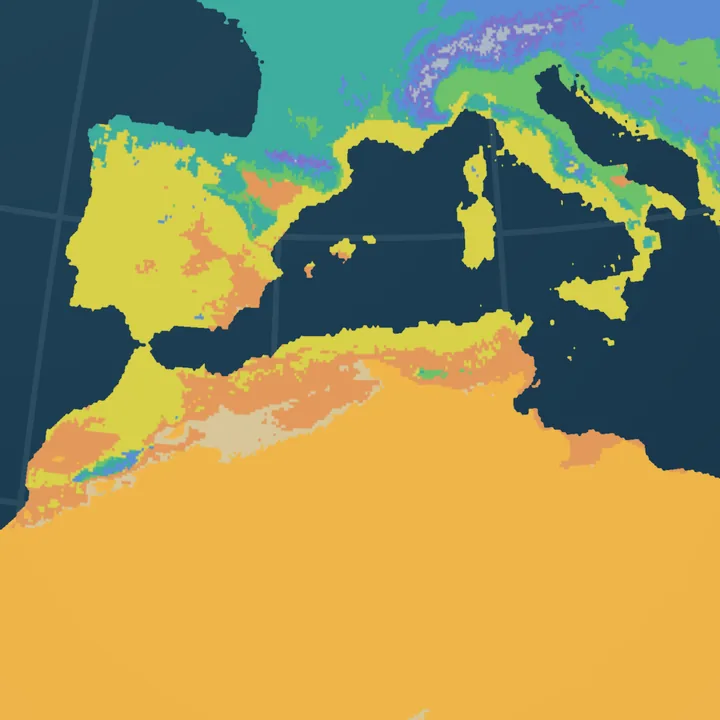
Algeria
Average temperature, rain and snow, sunshine and more for every month in Djelfa, from modelled 1981–2010 averages for the town itself (about 3 × 3 km around its centre).
Cold semi-arid · BSkOpen Djelfa on the globe ›Djelfa is warmest in July, with 35.8 °C (96 °F) days and 20.0 °C nights, and coolest in January, with 9.9 °C (50 °F) days and 0.4 °C nights. Most rain falls around January (32 mm); July is driest (9 mm).
- Day to day
- ±3.5 °Ca typical day’s swing from its month’s normal; most changeable in May (±4.9 °C)
- Year to year
- ±2.2 °Chow much a month’s average varies between years, most in May; least ±1.1 °C in August
- Record high
- 40.6 °C105 °F, 2023 · Djelfa/Tletsi station, 2 km away
- Record low
- -12.0 °C10 °F, 1978 · Djelfa/Tletsi station, 2 km away
- Best months
- May, Jun, Sep, Octmild and not too wet · where else is warm in May
- Year average15.5 °C60 °F
- Warmest · July27.9 °C82 °F
- Coolest · January5.2 °C41 °F
- Rain and snow a year268 mm10.5 in
- Sunshine a year3,078 habout 1961–1990
Climate type: Cold semi-arid (Köppen BSk) · about this type
Dry grassland climate with cold winters.
Djelfa at a glance
Among the 294 towns ClimaClue covers in Algeria, Djelfa is 259th warmest (15.5 °C year average), 48th sunniest (about 3,078 hours of sunshine a year) and 243rd wettest (268 mm a year), near the middle on each. Compared with Dar Chioukh, the nearest covered town with different numbers (32 km away), Djelfa is 0.1 °C cooler in July and 0.2 °C cooler in January, with 2 mm more precipitation a year. Its warmest month, July (27.9 °C), averages 22.7 °C more than its coolest, January (5.2 °C). No month has an average night low below 0 °C (32 °F); the coldest, January, averages 0.4 °C (single nights can be colder). The area lies about 231 km from the sea.
Station check: no NOAA GHCN-Daily station with 1981–2010 averages lies within 25 km of Djelfa, so these modelled values have not been compared with a nearby station.
Temperature and precipitation by month in Djelfa
Charts: ClimaClue area averages, CHELSA V2.1, 1981–2010. Hover or tap a point or bar for its value; every number is in the table below.
| Month | Average °C | Day high °C | Night low °C | Precipitation mm |
|---|---|---|---|---|
| January | 5.241 °F | 9.950 °F | 0.433 °F | 321.3 in |
| February | 6.844 °F | 11.753 °F | 1.935 °F | 241.0 in |
| March | 9.850 °F | 15.760 °F | 4.139 °F | 220.9 in |
| April | 12.955 °F | 19.066 °F | 6.944 °F | 271.1 in |
| May | 17.964 °F | 24.676 °F | 11.252 °F | 281.1 in |
| June | 23.975 °F | 31.188 °F | 16.762 °F | 150.6 in |
| July | 27.982 °F | 35.896 °F | 20.068 °F | 90.3 in |
| August | 26.980 °F | 34.594 °F | 19.367 °F | 160.6 in |
| September | 21.470 °F | 28.483 °F | 14.458 °F | 240.9 in |
| October | 15.961 °F | 21.871 °F | 9.950 °F | 261.0 in |
| November | 9.950 °F | 15.159 °F | 4.841 °F | 190.7 in |
| December | 6.343 °F | 11.152 °F | 1.635 °F | 271.1 in |
| Year | 15.560 °F | 21.671 °F | 9.349 °F | 26810.5 in |
Average: monthly mean air temperature, day and night together. Day high and night low: the month's average daily maximum and minimum (the CHELSA average plus and minus half the day–night range of CRU CL 2.0), not the hottest or coldest days. Precipitation: monthly total of rain and snow as water.
Sunshine, wind and humidity in Djelfa
| Month | Sunshine hours | Wind m/s | Humidity % | Dew point °C | Fresh snow cm |
|---|---|---|---|---|---|
| January | 204 | 3.16.9 mph | 70 | -0.631 °F | 8.33.3 in |
| February | 202 | 3.16.9 mph | 63 | -0.631 °F | 0.40.2 in |
| March | 238 | 3.16.9 mph | 55 | 0.132 °F | 0 |
| April | 251 | 3.37.4 mph | 48 | 1.134 °F | 0 |
| May | 293 | 3.16.9 mph | 42 | 3.538 °F | 0 |
| June | 316 | 2.86.3 mph | 33 | 5.141 °F | 0 |
| July | 348 | 2.65.8 mph | 26 | 4.740 °F | 0 |
| August | 322 | 2.55.6 mph | 29 | 6.043 °F | 0 |
| September | 265 | 2.55.6 mph | 45 | 7.445 °F | 0 |
| October | 240 | 2.65.8 mph | 55 | 5.842 °F | 0 |
| November | 202 | 2.96.5 mph | 65 | 2.837 °F | 0 |
| December | 198 | 3.27.2 mph | 72 | 0.934 °F | 0.80.3 in |
| Year | 3,078 | 2.96.5 mph | 50 | 3.037 °F | 9.53.7 in |
Sunshine: estimated hours of bright sunshine (not daylight length or solar energy); the source gives a percentage of possible daylight, converted to hours with astronomical day length; yearly total. Wind: monthly mean speed about 10 m above the ground; gusts and direction are not shown. Humidity: relative humidity, calculated from the month’s average dew point and its average night low and day high (an estimate, not a measurement). Dew point: how much water vapour the air holds. Fresh snow: estimated depth from ERA5-Land snowfall (1 mm of water ≈ 1 cm of snow), adjusted to snowfall measured at nearby weather stations. Year row: totals for sunshine and snow, averages otherwise.
Best time to visit Djelfa
For mild weather, the best months to visit Djelfa are May, June, September and October.
- Mild (average temperature 15–25 °C / 59–77 °F and under 100 mm / 3.9 in of precipitation): May, June, September and October.
- Warmest (average temperature): July (27.9 °C), August (26.9 °C) and June (23.9 °C).
- Driest (least precipitation): July (9 mm), June (15 mm) and August (16 mm).
- Sunniest (hours of sunshine, about 1961–1990): July (348 h), August (322 h) and June (316 h).
Climate only: these rules use 1981–2010 monthly averages and do not consider crowds, prices, events or holidays; any one year can differ.
Djelfa weather month by month
Average conditions for each month (1981–2010 monthly averages; sunshine about 1961–1990), not forecasts.
Djelfa weather in January
Day high 9.9 °C (50 °F) · night low 0.4 °C (33 °F) · average 5.2 °C · precipitation 32 mm (1.3 in) · sunshine about 204 hours · humidity 70% · dew point -0.6 °C · fresh snow about 8.3 cm.
Compared with December: 1.2 °C cooler, 5 mm more precipitation and 6 hours more sunshine.
Djelfa weather in February
Day high 11.7 °C (53 °F) · night low 1.9 °C (35 °F) · average 6.8 °C · precipitation 24 mm (1.0 in) · sunshine about 202 hours · humidity 63% · dew point -0.6 °C.
Compared with January: 1.6 °C warmer, 8 mm less precipitation and 2 hours less sunshine.
Djelfa weather in March
Day high 15.7 °C (60 °F) · night low 4.1 °C (39 °F) · average 9.8 °C · precipitation 22 mm (0.9 in) · sunshine about 238 hours · humidity 55% · dew point 0.1 °C.
Compared with February: 3.1 °C warmer, 3 mm less precipitation and 36 hours more sunshine.
Djelfa weather in April
Day high 19.0 °C (66 °F) · night low 6.9 °C (44 °F) · average 12.9 °C · precipitation 27 mm (1.1 in) · sunshine about 251 hours · humidity 48% · dew point 1.1 °C.
Compared with March: 3.1 °C warmer, 5 mm more precipitation and 13 hours more sunshine.
Djelfa weather in May
Day high 24.6 °C (76 °F) · night low 11.2 °C (52 °F) · average 17.9 °C · precipitation 28 mm (1.1 in) · sunshine about 293 hours · humidity 42% · dew point 3.5 °C.
Compared with April: 5.0 °C warmer, 1 mm more precipitation and 42 hours more sunshine.
Djelfa weather in June
Day high 31.1 °C (88 °F) · night low 16.7 °C (62 °F) · average 23.9 °C · precipitation 15 mm (0.6 in) · sunshine about 316 hours · humidity 33% · dew point 5.1 °C.
Compared with May: 6.0 °C warmer, 13 mm less precipitation and 23 hours more sunshine.
Djelfa weather in July
Day high 35.8 °C (96 °F) · night low 20.0 °C (68 °F) · average 27.9 °C · precipitation 9 mm (0.3 in) · sunshine about 348 hours · humidity 26% · dew point 4.7 °C.
Compared with June: 3.9 °C warmer, 6 mm less precipitation and 32 hours more sunshine.
Djelfa weather in August
Day high 34.5 °C (94 °F) · night low 19.3 °C (67 °F) · average 26.9 °C · precipitation 16 mm (0.6 in) · sunshine about 322 hours · humidity 29% · dew point 6.0 °C.
Compared with July: 1.0 °C cooler, 7 mm more precipitation and 26 hours less sunshine.
Djelfa weather in September
Day high 28.4 °C (83 °F) · night low 14.4 °C (58 °F) · average 21.4 °C · precipitation 24 mm (0.9 in) · sunshine about 265 hours · humidity 45% · dew point 7.4 °C.
Compared with August: 5.6 °C cooler, 9 mm more precipitation and 57 hours less sunshine.
Djelfa weather in October
Day high 21.8 °C (71 °F) · night low 9.9 °C (50 °F) · average 15.9 °C · precipitation 26 mm (1.0 in) · sunshine about 240 hours · humidity 55% · dew point 5.8 °C.
Compared with September: 5.5 °C cooler, 2 mm more precipitation and 26 hours less sunshine.
Djelfa weather in November
Day high 15.1 °C (59 °F) · night low 4.8 °C (41 °F) · average 9.9 °C · precipitation 19 mm (0.7 in) · sunshine about 202 hours · humidity 65% · dew point 2.8 °C.
Compared with October: 5.9 °C cooler, 7 mm less precipitation and 38 hours less sunshine.
Djelfa weather in December
Day high 11.1 °C (52 °F) · night low 1.6 °C (35 °F) · average 6.3 °C · precipitation 27 mm (1.1 in) · sunshine about 198 hours · humidity 72% · dew point 0.9 °C · fresh snow about 0.8 cm.
Compared with November: 3.6 °C cooler, 8 mm more precipitation and 4 hours less sunshine.
Why Djelfa has this climate
Typical mechanisms for this climate type, plus facts measured for this place; not a verified local cause.
Dry air allows wide temperature swings; the seasons are often sharp. It sits on the edge of a desert: some rain-bearing systems reach it in one season, but not enough to make it humid. About 231 km from the sea: inland, so ocean moderation is weaker and seasons are usually sharper. Here the coolest and warmest months differ by 22.7 °C.
Rain or snow is spread through much of the year.
Djelfa climate: questions and answers
- What is the warmest month in Djelfa?
- July, with an average of 27.9 °C (82 °F), day highs around 35.8 °C (96 °F) and night lows around 20.0 °C (68 °F).
- What is the coldest month in Djelfa?
- January, with an average of 5.2 °C (41 °F), day highs around 9.9 °C (50 °F) and night lows around 0.4 °C (33 °F).
- Which month gets the most rain in Djelfa?
- January, with 32 mm (1.3 in) of precipitation (rain and snow as water), out of 268 mm (10.5 in) in a typical year.
- What is the driest month in Djelfa?
- July, with 9 mm (0.3 in) of precipitation.
- What is the sunniest month in Djelfa?
- July, with about 348 hours of bright sunshine (estimate for about 1961–1990).
- Does it snow in Djelfa?
- Yes. About 9.5 cm (3.7 in) of fresh snow falls in a typical year (ERA5-Land snowfall at 1 mm of water ≈ 1 cm of snow, adjusted to nearby weather stations), most in January; it usually melts within days.
- When is the best time to visit Djelfa?
- For mild weather (average temperature 15–25 °C / 59–77 °F and under 100 mm / 3.9 in of precipitation): May, June, September and October. Climate only, from 1981–2010 averages: crowds and prices are not considered.
- What type of climate does Djelfa have?
- Cold semi-arid (Köppen BSk). Dry grassland climate with cold winters. Calculated from the town’s own 1981–2010 monthly averages.
Nearby towns in Algeria
- Dar Chioukh32 km · BSk · 265 mm a year15.6 °C
- ’Aïn el Bell37 km · BSk · 255 mm a year16.9 °C
- Charef43 km · BSk · 309 mm a year15.3 °C
- Hassi Bahbah49 km · BSk · 285 mm a year16.6 °C
- Feidh el Botma50 km · BSk · 239 mm a year16.2 °C
- Messaad62 km · BWh · 172 mm a year18.6 °C
Compare: Baku vs Djelfa
Appears in: Snowiest Cities in Africa (#4) · Snowiest Cities in Algeria (#4) · Sunniest Cities in Algeria (#8) · Coldest Cities in Algeria (#9) · Driest Cities in Algeria (#10) · Cities With the Hottest Summers in Algeria (#12)
Climate twins elsewhere
Towns in other countries whose monthly temperature and rain pattern is closest to Djelfa’s (the measure used by ClimaClue’s Climate Twins game; seasons are lined up across hemispheres).
- Zaragoza, SpainBSk · months typically 1.4 °C apart
- Pārsābād, IranBSk · months typically 1.5 °C apart
- Sumgayit, AzerbaijanBSk · months typically 1.6 °C apart
- Thessaloníki, GreeceCfa · months typically 0.9 °C apart
- Kırıkkale, TurkeyBSk · months typically 1.8 °C apart
About these numbers
Temperature, precipitation and wind: modelled monthly averages (climate normals) for Djelfa itself, the average of the ~1 km source cells in the 3 × 3 km around its GeoNames location (34.673°N, 3.263°E). Day highs and night lows add the day–night range of the surrounding CRU cell (about 18 km), or on a few small islands the nearest weather station’s; where there is neither, they are not shown. Sunshine, dew point and snow come from coarser sources and describe the 0.1° area around it, about 9.2 × 11 km (ClimaClue area sq-493-1832), which is also what the globe shows when you click there; humidity is calculated from that dew point and the town’s own night lows and day highs. They are model estimates, not measurements at a weather station, and not forecasts. Sources: CHELSA V2.1, 1981–2010 (temperature, precipitation, wind); ERA5-Land, 1981–2010 (dew point and snow; snowfall matched to the area’s CHELSA climate; contains modified Copernicus Climate Change Service information); relative humidity calculated from the dew point and the night lows and day highs; CRU CL 2.0, about 1961–1990 (sunshine and the day–night range; a different period); GeoNames (name and population 265,833, CC BY 4.0); climate type by the Köppen–Geiger rules of Peel et al. (2007). How ClimaClue makes these numbers.