 ClimaClue
Nova Ipixuna weather by month and climate
Pará · Brazil
Average temperature, rain and snow, sunshine and more for every month in Nova Ipixuna, from modelled 1981–2010 averages for the town itself (about 3 × 3 km around its centre).
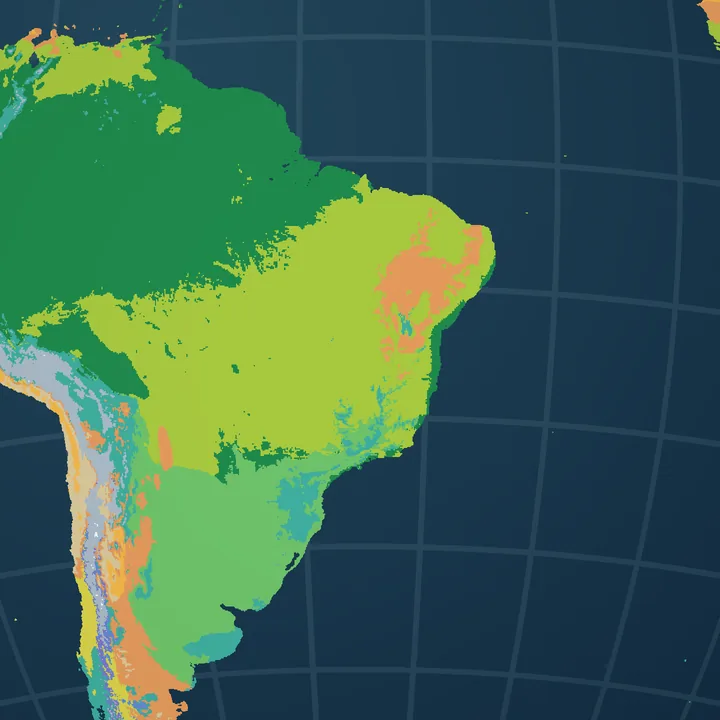
Tropical monsoon · AmOpen Nova Ipixuna on the globe ›Nova Ipixuna is warm all year: days stay between 29.8 °C and 33.8 °C. Most rain falls around March (460 mm); August is driest (16 mm).
- Day to day
- ±0.9 °Ca typical day’s swing from its month’s normal; most changeable in September (±1.1 °C)
- Year to year
- ±0.9 °Chow much a month’s average varies between years, most in September; least ±0.5 °C in December
- Best months
- Jan, Feb, Marclosest to mild and dry · where else is warm in January
- Year average26.5 °C80 °F
- Warmest · September27.9 °C82 °F
- Coolest · February25.5 °C78 °F
- Rain and snow a year2,291 mm90.2 in
- Sunshine a year1,912 habout 1961–1990
Climate type: Tropical monsoon (Köppen Am) · about this type
Hot all year, with a very wet monsoon season and a short drier spell.
Nova Ipixuna at a glance
Among the 2275 towns ClimaClue covers in Brazil, Nova Ipixuna is 419th warmest (26.5 °C year average), 1944th sunniest (about 1,912 hours of sunshine a year) and 136th wettest (2,291 mm a year), near the middle on each. Compared with Itupiranga, the nearest covered town with different numbers (37 km away), Nova Ipixuna is 0.4 °C cooler in September and 0.3 °C cooler in February, with 247 mm more precipitation a year. Its warmest month, September (27.9 °C), averages 2.4 °C more than its coolest, February (25.5 °C). Even the coolest nights average 21.1 °C (70 °F), in February. The area lies about 324 km from the sea.
Station check: no NOAA GHCN-Daily station with 1981–2010 averages lies within 25 km of Nova Ipixuna, so these modelled values have not been compared with a nearby station.
Temperature and precipitation by month in Nova Ipixuna
Charts: ClimaClue area averages, CHELSA V2.1, 1981–2010. Hover or tap a point or bar for its value; every number is in the table below.
| Month | Average °C | Day high °C | Night low °C | Precipitation mm |
|---|---|---|---|---|
| January | 25.678 °F | 30.086 °F | 21.270 °F | 35313.9 in |
| February | 25.578 °F | 29.886 °F | 21.170 °F | 37914.9 in |
| March | 25.678 °F | 29.986 °F | 21.270 °F | 46018.1 in |
| April | 25.979 °F | 30.487 °F | 21.471 °F | 32112.6 in |
| May | 26.379 °F | 31.188 °F | 21.471 °F | 1485.8 in |
| June | 26.680 °F | 32.090 °F | 21.270 °F | 411.6 in |
| July | 27.181 °F | 33.091 °F | 21.270 °F | 200.8 in |
| August | 27.882 °F | 33.893 °F | 21.771 °F | 160.6 in |
| September | 27.982 °F | 33.392 °F | 22.573 °F | 421.7 in |
| October | 27.381 °F | 32.490 °F | 22.272 °F | 1024.0 in |
| November | 26.680 °F | 31.589 °F | 21.871 °F | 1656.5 in |
| December | 26.079 °F | 30.687 °F | 21.471 °F | 2449.6 in |
| Year | 26.580 °F | 31.589 °F | 21.571 °F | 2,29190.2 in |
Average: monthly mean air temperature, day and night together. Day high and night low: the month's average daily maximum and minimum (the CHELSA average plus and minus half the day–night range of CRU CL 2.0), not the hottest or coldest days. Precipitation: monthly total of rain and snow as water.
Sunshine, wind and humidity in Nova Ipixuna
| Month | Sunshine hours | Wind m/s | Humidity % | Dew point °C |
|---|---|---|---|---|
| January | 130 | 1.63.6 mph | 83 | 23.073 °F |
| February | 113 | 1.73.8 mph | 83 | 22.973 °F |
| March | 136 | 1.73.8 mph | 83 | 23.073 °F |
| April | 155 | 1.63.6 mph | 83 | 23.274 °F |
| May | 200 | 1.84.0 mph | 81 | 23.073 °F |
| June | 230 | 2.24.9 mph | 77 | 21.571 °F |
| July | 246 | 2.55.6 mph | 67 | 19.467 °F |
| August | 209 | 2.65.8 mph | 63 | 19.066 °F |
| September | 137 | 2.45.4 mph | 68 | 20.669 °F |
| October | 120 | 2.04.5 mph | 78 | 22.372 °F |
| November | 116 | 1.84.0 mph | 80 | 23.073 °F |
| December | 122 | 1.63.6 mph | 82 | 23.274 °F |
| Year | 1,912 | 2.04.4 mph | 77 | 22.072 °F |
Sunshine: estimated hours of bright sunshine (not daylight length or solar energy); the source gives a percentage of possible daylight, converted to hours with astronomical day length; yearly total. Wind: monthly mean speed about 10 m above the ground; gusts and direction are not shown. Humidity: relative humidity, calculated from the month’s average dew point and its average night low and day high (an estimate, not a measurement). Dew point: how much water vapour the air holds. Year row: totals for sunshine and snow, averages otherwise.
Best time to visit Nova Ipixuna
No month in Nova Ipixuna is mild by the rule below; the closest in temperature are January (25.6 °C, 353 mm), February (25.5 °C, 379 mm) and March (25.6 °C, 460 mm).
- Mild (average temperature 15–25 °C / 59–77 °F and under 100 mm / 3.9 in of precipitation): no month.
- Warmest (average temperature): September (27.9 °C), August (27.8 °C) and October (27.3 °C).
- Driest (least precipitation): August (16 mm), July (20 mm) and June (41 mm).
- Sunniest (hours of sunshine, about 1961–1990): July (246 h), June (230 h) and August (209 h).
Climate only: these rules use 1981–2010 monthly averages and do not consider crowds, prices, events or holidays; any one year can differ.
Nova Ipixuna weather month by month
Average conditions for each month (1981–2010 monthly averages; sunshine about 1961–1990), not forecasts.
Nova Ipixuna weather in January
Day high 30.0 °C (86 °F) · night low 21.2 °C (70 °F) · average 25.6 °C · precipitation 353 mm (13.9 in) · sunshine about 130 hours · humidity 83% · dew point 23.0 °C.
Compared with December: 0.5 °C cooler, 109 mm more precipitation and 7 hours more sunshine.
Nova Ipixuna weather in February
Day high 29.8 °C (86 °F) · night low 21.1 °C (70 °F) · average 25.5 °C · precipitation 379 mm (14.9 in) · sunshine about 113 hours · humidity 83% · dew point 22.9 °C.
Compared with January: 0.1 °C cooler, 26 mm more precipitation and 16 hours less sunshine.
Nova Ipixuna weather in March
Day high 29.9 °C (86 °F) · night low 21.2 °C (70 °F) · average 25.6 °C · precipitation 460 mm (18.1 in) · sunshine about 136 hours · humidity 83% · dew point 23.0 °C.
Compared with February: 0.1 °C warmer, 82 mm more precipitation and 22 hours more sunshine.
Nova Ipixuna weather in April
Day high 30.4 °C (87 °F) · night low 21.4 °C (71 °F) · average 25.9 °C · precipitation 321 mm (12.6 in) · sunshine about 155 hours · humidity 83% · dew point 23.2 °C.
Compared with March: 0.3 °C warmer, 139 mm less precipitation and 19 hours more sunshine.
Nova Ipixuna weather in May
Day high 31.1 °C (88 °F) · night low 21.4 °C (71 °F) · average 26.3 °C · precipitation 148 mm (5.8 in) · sunshine about 200 hours · humidity 81% · dew point 23.0 °C.
Compared with April: 0.4 °C warmer, 173 mm less precipitation and 45 hours more sunshine.
Nova Ipixuna weather in June
Day high 32.0 °C (90 °F) · night low 21.2 °C (70 °F) · average 26.6 °C · precipitation 41 mm (1.6 in) · sunshine about 230 hours · humidity 77% · dew point 21.5 °C.
Compared with May: 0.3 °C warmer, 108 mm less precipitation and 31 hours more sunshine.
Nova Ipixuna weather in July
Day high 33.0 °C (91 °F) · night low 21.2 °C (70 °F) · average 27.1 °C · precipitation 20 mm (0.8 in) · sunshine about 246 hours · humidity 67% · dew point 19.4 °C.
Compared with June: 0.5 °C warmer, 21 mm less precipitation and 16 hours more sunshine.
Nova Ipixuna weather in August
Day high 33.8 °C (93 °F) · night low 21.7 °C (71 °F) · average 27.8 °C · precipitation 16 mm (0.6 in) · sunshine about 209 hours · humidity 63% · dew point 19.0 °C.
Compared with July: 0.7 °C warmer, 3 mm less precipitation and 37 hours less sunshine.
Nova Ipixuna weather in September
Day high 33.3 °C (92 °F) · night low 22.5 °C (73 °F) · average 27.9 °C · precipitation 42 mm (1.7 in) · sunshine about 137 hours · humidity 68% · dew point 20.6 °C.
Compared with August: 0.1 °C warmer, 26 mm more precipitation and 72 hours less sunshine.
Nova Ipixuna weather in October
Day high 32.4 °C (90 °F) · night low 22.2 °C (72 °F) · average 27.3 °C · precipitation 102 mm (4.0 in) · sunshine about 120 hours · humidity 78% · dew point 22.3 °C.
Compared with September: 0.6 °C cooler, 59 mm more precipitation and 16 hours less sunshine.
Nova Ipixuna weather in November
Day high 31.5 °C (89 °F) · night low 21.8 °C (71 °F) · average 26.6 °C · precipitation 165 mm (6.5 in) · sunshine about 116 hours · humidity 80% · dew point 23.0 °C.
Compared with October: 0.6 °C cooler, 63 mm more precipitation and 5 hours less sunshine.
Nova Ipixuna weather in December
Day high 30.6 °C (87 °F) · night low 21.4 °C (71 °F) · average 26.0 °C · precipitation 244 mm (9.6 in) · sunshine about 122 hours · humidity 82% · dew point 23.2 °C.
Compared with November: 0.6 °C cooler, 79 mm more precipitation and 7 hours more sunshine.
Why Nova Ipixuna has this climate
Typical mechanisms for this climate type, plus facts measured for this place; not a verified local cause.
The tropical sun keeps it warm all year; the hottest weeks often come just before the rains. Seasonal monsoon winds bring a very wet season, and a short dry season follows when they reverse. About 324 km from the sea: inland, so ocean moderation is weaker and seasons are usually sharper. Here the coolest and warmest months differ by 2.4 °C.
Strongly seasonal: the wettest month gets more than five times the driest.
Nova Ipixuna climate: questions and answers
- What is the warmest month in Nova Ipixuna?
- September, with an average of 27.9 °C (82 °F), day highs around 33.3 °C (92 °F) and night lows around 22.5 °C (73 °F).
- What is the coldest month in Nova Ipixuna?
- February, with an average of 25.5 °C (78 °F), day highs around 29.8 °C (86 °F) and night lows around 21.1 °C (70 °F).
- Which month gets the most rain in Nova Ipixuna?
- March, with 460 mm (18.1 in) of precipitation (rain and snow as water), out of 2,291 mm (90.2 in) in a typical year.
- What is the driest month in Nova Ipixuna?
- August, with 16 mm (0.6 in) of precipitation.
- What is the sunniest month in Nova Ipixuna?
- July, with about 246 hours of bright sunshine (estimate for about 1961–1990).
- Does it snow in Nova Ipixuna?
- Not in a typical year: ERA5-Land gives less than 1 cm of fresh snow a year for this area (1981–2010).
- When is the best time to visit Nova Ipixuna?
- No month is mild by the rule used here (average temperature 15–25 °C / 59–77 °F and under 100 mm / 3.9 in of precipitation); the closest in temperature are January, February and March. Climate only, from 1981–2010 averages: crowds and prices are not considered.
- What type of climate does Nova Ipixuna have?
- Tropical monsoon (Köppen Am). Hot all year, with a very wet monsoon season and a short drier spell. Calculated from the town’s own 1981–2010 monthly averages.
Nearby towns in Brazil
- Itupiranga37 km · Aw · 2,044 mm a year26.8 °C
- Marabá52 km · Aw · 1,927 mm a year26.8 °C
- Jacundá53 km · Am · 2,235 mm a year26.8 °C
- Bom Jesus do Tocantins54 km · Aw · 2,050 mm a year26.7 °C
- São Domingos do Araguaia78 km · Aw · 1,916 mm a year26.7 °C
- Novo Repartimento103 km · Am · 2,677 mm a year27.1 °C
Climate twins elsewhere
Towns in other countries whose monthly temperature and rain pattern is closest to Nova Ipixuna’s (the measure used by ClimaClue’s Climate Twins game; seasons are lined up across hemispheres).
- Đồng Xoài, VietnamAm · months typically 0.9 °C apart · seasons reversed
- Guanare, VenezuelaAm · months typically 0.5 °C apart · seasons reversed
- Kollam, IndiaAm · months typically 0.6 °C apart · seasons reversed
- Mojokerto, IndonesiaAm · months typically 0.8 °C apart
- Malabo, Equatorial GuineaAm · months typically 0.6 °C apart · seasons reversed
About these numbers
Temperature, precipitation and wind: modelled monthly averages (climate normals) for Nova Ipixuna itself, the average of the ~1 km source cells in the 3 × 3 km around its GeoNames location (4.921°S, 49.077°W). Day highs and night lows add the day–night range of the surrounding CRU cell (about 18 km), or on a few small islands the nearest weather station’s; where there is neither, they are not shown. Sunshine, dew point and snow come from coarser sources and describe the 0.1° area around it, about 11 × 11 km (ClimaClue area sq-889-1309), which is also what the globe shows when you click there; humidity is calculated from that dew point and the town’s own night lows and day highs. They are model estimates, not measurements at a weather station, and not forecasts. Sources: CHELSA V2.1, 1981–2010 (temperature, precipitation, wind); ERA5-Land, 1981–2010 (dew point and snow; snowfall matched to the area’s CHELSA climate; contains modified Copernicus Climate Change Service information); relative humidity calculated from the dew point and the night lows and day highs; CRU CL 2.0, about 1961–1990 (sunshine and the day–night range; a different period); GeoNames (name and population 16,854, CC BY 4.0); climate type by the Köppen–Geiger rules of Peel et al. (2007). How ClimaClue makes these numbers.