 ClimaClue
Same weather by month and climate
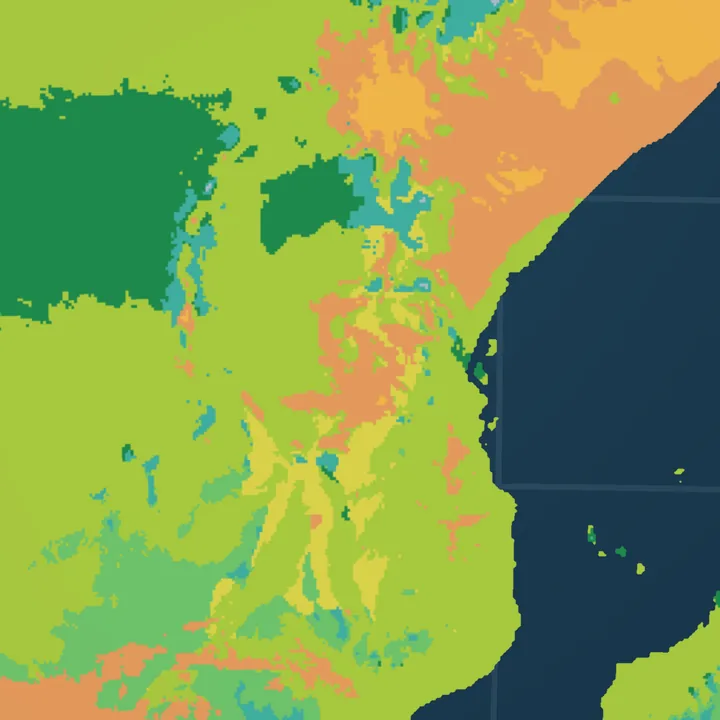
Kilimanjaro · Tanzania
Average temperature, rain and snow, sunshine and more for every month in Same, from modelled 1981–2010 averages for the town itself (about 3 × 3 km around its centre).
Tropical savanna · AwOpen Same on the globe ›Same is warmest in February, with 31.8 °C (89 °F) days and 19.0 °C nights, and coolest in July, with 25.0 °C (77 °F) days and 14.9 °C nights. Most rain falls around April (141 mm); July is driest (7 mm).
- Day to day
- ±1.0 °Ca typical day’s swing from its month’s normal; most changeable in March (±1.2 °C)
- Year to year
- ±0.9 °Chow much a month’s average varies between years, most in January; least ±0.5 °C in June
- Best months
- Jan, May, Jun, Jul, Aug, Sep, Oct, Nov, Decmild and not too wet · where else is warm in January
- Year average23.0 °C73 °F
- Warmest · February25.4 °C78 °F
- Coolest · July19.9 °C68 °F
- Rain and snow a year662 mm26.1 in
- Sunshine a year2,531 habout 1961–1990
Climate type: Tropical savanna (Köppen Aw) · about this type
Hot all year, with a clear wet season and a clear dry season.
Borderline: rainfall is close to the dry-climate threshold.
Same at a glance
Among the 227 towns ClimaClue covers in Tanzania, Same is 105th warmest (23.0 °C year average), 200th sunniest (about 2,531 hours of sunshine a year) and 214th wettest (662 mm a year), near the middle on each. Compared with Lembeni, the nearest covered town with different numbers (34 km away), Same is 1.1 °C warmer in February and 1.2 °C warmer in July, with 32 mm less precipitation a year. Its warmest month, February (25.4 °C), averages 5.5 °C more than its coolest, July (19.9 °C). Even the coolest nights average 14.9 °C (59 °F), in July. The area lies about 194 km from the sea.
Station check: no NOAA GHCN-Daily station with 1981–2010 averages lies within 25 km of Same, so these modelled values have not been compared with a nearby station.
Temperature and precipitation by month in Same
Charts: ClimaClue area averages, CHELSA V2.1, 1981–2010. Hover or tap a point or bar for its value; every number is in the table below.
| Month | Average °C | Day high °C | Night low °C | Precipitation mm |
|---|---|---|---|---|
| January | 24.777 °F | 30.587 °F | 19.066 °F | 542.1 in |
| February | 25.478 °F | 31.889 °F | 19.066 °F | 391.5 in |
| March | 25.277 °F | 31.589 °F | 18.966 °F | 903.5 in |
| April | 23.674 °F | 28.583 °F | 18.866 °F | 1415.6 in |
| May | 22.072 °F | 26.480 °F | 17.664 °F | 833.3 in |
| June | 20.669 °F | 25.578 °F | 15.760 °F | 170.7 in |
| July | 19.968 °F | 25.077 °F | 14.959 °F | 70.3 in |
| August | 20.669 °F | 26.179 °F | 15.059 °F | 130.5 in |
| September | 21.971 °F | 28.183 °F | 15.660 °F | 130.5 in |
| October | 23.274 °F | 29.585 °F | 17.063 °F | 502.0 in |
| November | 24.175 °F | 29.685 °F | 18.565 °F | 793.1 in |
| December | 24.476 °F | 29.886 °F | 19.166 °F | 773.0 in |
| Year | 23.073 °F | 28.583 °F | 17.463 °F | 66226.1 in |
Average: monthly mean air temperature, day and night together. Day high and night low: the month's average daily maximum and minimum (the CHELSA average plus and minus half the day–night range of CRU CL 2.0), not the hottest or coldest days. Precipitation: monthly total of rain and snow as water.
Sunshine, wind and humidity in Same
| Month | Sunshine hours | Wind m/s | Humidity % | Dew point °C |
|---|---|---|---|---|
| January | 271 | 2.86.3 mph | 65 | 16.762 °F |
| February | 243 | 2.76.0 mph | 62 | 16.361 °F |
| March | 247 | 2.55.6 mph | 66 | 17.363 °F |
| April | 180 | 2.55.6 mph | 74 | 18.064 °F |
| May | 156 | 2.86.3 mph | 74 | 16.662 °F |
| June | 172 | 3.16.9 mph | 69 | 14.057 °F |
| July | 173 | 3.27.2 mph | 66 | 12.755 °F |
| August | 176 | 3.06.7 mph | 65 | 12.755 °F |
| September | 198 | 2.86.3 mph | 63 | 13.356 °F |
| October | 237 | 2.76.0 mph | 63 | 14.758 °F |
| November | 239 | 2.65.8 mph | 66 | 16.562 °F |
| December | 239 | 2.86.3 mph | 68 | 17.263 °F |
| Year | 2,531 | 2.86.2 mph | 67 | 15.560 °F |
Sunshine: estimated hours of bright sunshine (not daylight length or solar energy); the source gives a percentage of possible daylight, converted to hours with astronomical day length; yearly total. Wind: monthly mean speed about 10 m above the ground; gusts and direction are not shown. Humidity: relative humidity, calculated from the month’s average dew point and its average night low and day high (an estimate, not a measurement). Dew point: how much water vapour the air holds. Year row: totals for sunshine and snow, averages otherwise.
Best time to visit Same
For mild weather, the best months to visit Same are January, May, June, July, August, September, October, November and December.
- Mild (average temperature 15–25 °C / 59–77 °F and under 100 mm / 3.9 in of precipitation): January, May, June, July, August, September, October, November and December.
- Warmest (average temperature): February (25.4 °C), March (25.2 °C) and January (24.7 °C).
- Driest (least precipitation): July (7 mm), September (13 mm) and August (13 mm).
- Sunniest (hours of sunshine, about 1961–1990): January (271 h), March (247 h) and February (243 h).
Climate only: these rules use 1981–2010 monthly averages and do not consider crowds, prices, events or holidays; any one year can differ.
Same weather month by month
Average conditions for each month (1981–2010 monthly averages; sunshine about 1961–1990), not forecasts.
Same weather in January
Day high 30.5 °C (87 °F) · night low 19.0 °C (66 °F) · average 24.7 °C · precipitation 54 mm (2.1 in) · sunshine about 271 hours · humidity 65% · dew point 16.7 °C.
Compared with December: 0.3 °C warmer, 24 mm less precipitation and 32 hours more sunshine.
Same weather in February
Day high 31.8 °C (89 °F) · night low 19.0 °C (66 °F) · average 25.4 °C · precipitation 39 mm (1.5 in) · sunshine about 243 hours · humidity 62% · dew point 16.3 °C.
Compared with January: 0.7 °C warmer, 15 mm less precipitation and 28 hours less sunshine.
Same weather in March
Day high 31.5 °C (89 °F) · night low 18.9 °C (66 °F) · average 25.2 °C · precipitation 90 mm (3.5 in) · sunshine about 247 hours · humidity 66% · dew point 17.3 °C.
Compared with February: 0.2 °C cooler, 51 mm more precipitation and 5 hours more sunshine.
Same weather in April
Day high 28.5 °C (83 °F) · night low 18.8 °C (66 °F) · average 23.6 °C · precipitation 141 mm (5.6 in) · sunshine about 180 hours · humidity 74% · dew point 18.0 °C.
Compared with March: 1.6 °C cooler, 52 mm more precipitation and 67 hours less sunshine.
Same weather in May
Day high 26.4 °C (80 °F) · night low 17.6 °C (64 °F) · average 22.0 °C · precipitation 83 mm (3.3 in) · sunshine about 156 hours · humidity 74% · dew point 16.6 °C.
Compared with April: 1.6 °C cooler, 59 mm less precipitation and 23 hours less sunshine.
Same weather in June
Day high 25.5 °C (78 °F) · night low 15.7 °C (60 °F) · average 20.6 °C · precipitation 17 mm (0.7 in) · sunshine about 172 hours · humidity 69% · dew point 14.0 °C.
Compared with May: 1.4 °C cooler, 66 mm less precipitation and 16 hours more sunshine.
Same weather in July
Day high 25.0 °C (77 °F) · night low 14.9 °C (59 °F) · average 19.9 °C · precipitation 7 mm (0.3 in) · sunshine about 173 hours · humidity 66% · dew point 12.7 °C.
Compared with June: 0.7 °C cooler, 9 mm less precipitation and 1 hours more sunshine.
Same weather in August
Day high 26.1 °C (79 °F) · night low 15.0 °C (59 °F) · average 20.6 °C · precipitation 13 mm (0.5 in) · sunshine about 176 hours · humidity 65% · dew point 12.7 °C.
Compared with July: 0.6 °C warmer, 6 mm more precipitation and 2 hours more sunshine.
Same weather in September
Day high 28.1 °C (83 °F) · night low 15.6 °C (60 °F) · average 21.9 °C · precipitation 13 mm (0.5 in) · sunshine about 198 hours · humidity 63% · dew point 13.3 °C.
Compared with August: 1.3 °C warmer, 1 mm less precipitation and 23 hours more sunshine.
Same weather in October
Day high 29.5 °C (85 °F) · night low 17.0 °C (63 °F) · average 23.2 °C · precipitation 50 mm (2.0 in) · sunshine about 237 hours · humidity 63% · dew point 14.7 °C.
Compared with September: 1.3 °C warmer, 37 mm more precipitation and 39 hours more sunshine.
Same weather in November
Day high 29.6 °C (85 °F) · night low 18.5 °C (65 °F) · average 24.1 °C · precipitation 79 mm (3.1 in) · sunshine about 239 hours · humidity 66% · dew point 16.5 °C.
Compared with October: 0.9 °C warmer, 29 mm more precipitation and 2 hours more sunshine.
Same weather in December
Day high 29.8 °C (86 °F) · night low 19.1 °C (66 °F) · average 24.4 °C · precipitation 77 mm (3.0 in) · sunshine about 239 hours · humidity 68% · dew point 17.2 °C.
Compared with November: 0.3 °C warmer, 2 mm less precipitation and about the same sunshine.
Why Same has this climate
Typical mechanisms for this climate type, plus facts measured for this place; not a verified local cause.
It stays warm all year; the dry season brings clearer skies and wider day–night swings. The tropical rain belt follows the sun: it brings a wet season when overhead and a long dry season when it moves away. About 194 km from the sea: inland, so ocean moderation is weaker and seasons are usually sharper. Here the coolest and warmest months differ by 5.5 °C. The 10 km area around Same, which the globe shows when you click there, averages 21.8 °C a year, 1.2 °C cooler than the town itself, because it takes in higher ground.
Strongly seasonal: the wettest month gets more than five times the driest.
Same climate: questions and answers
- What is the warmest month in Same?
- February, with an average of 25.4 °C (78 °F), day highs around 31.8 °C (89 °F) and night lows around 19.0 °C (66 °F).
- What is the coldest month in Same?
- July, with an average of 19.9 °C (68 °F), day highs around 25.0 °C (77 °F) and night lows around 14.9 °C (59 °F).
- Which month gets the most rain in Same?
- April, with 141 mm (5.6 in) of precipitation (rain and snow as water), out of 662 mm (26.1 in) in a typical year.
- What is the driest month in Same?
- July, with 7 mm (0.3 in) of precipitation.
- What is the sunniest month in Same?
- January, with about 271 hours of bright sunshine (estimate for about 1961–1990).
- Does it snow in Same?
- Not in a typical year: ERA5-Land gives less than 1 cm of fresh snow a year for this area (1981–2010).
- When is the best time to visit Same?
- For mild weather (average temperature 15–25 °C / 59–77 °F and under 100 mm / 3.9 in of precipitation): January, May, June, July, August, September, October, November and December. Climate only, from 1981–2010 averages: crowds and prices are not considered.
- What type of climate does Same have?
- Tropical savanna (Köppen Aw). Hot all year, with a clear wet season and a clear dry season. Calculated from the town’s own 1981–2010 monthly averages.
Nearby towns in Tanzania
- Lembeni34 km · Aw · 694 mm a year21.8 °C
- Usangi41 km · Csa · 877 mm a year20.0 °C
- Hedaru52 km · Aw · 697 mm a year23.8 °C
- Makuyuni, Tanga84 km · Aw · 980 mm a year24.8 °C
- Moshi91 km · Aw · 1,143 mm a year22.9 °C
- Mazinde98 km · Aw · 1,290 mm a year23.2 °C
Climate twins elsewhere
Towns in other countries whose monthly temperature and rain pattern is closest to Same’s (the measure used by ClimaClue’s Climate Twins game; seasons are lined up across hemispheres).
- Maputo, MozambiqueAw · months typically 0.6 °C apart
- Teófilo Otoni, BrazilAw · months typically 0.9 °C apart
- Hosūr, IndiaAw · months typically 2.1 °C apart · seasons reversed
- Tegucigalpa, HondurasAw · months typically 1.5 °C apart · seasons reversed
- Mwala, KenyaAw · months typically 2.1 °C apart
About these numbers
Temperature, precipitation and wind: modelled monthly averages (climate normals) for Same itself, the average of the ~1 km source cells in the 3 × 3 km around its GeoNames location (4.067°S, 37.733°E). Day highs and night lows add the day–night range of the surrounding CRU cell (about 18 km), or on a few small islands the nearest weather station’s; where there is neither, they are not shown. Sunshine, dew point and snow come from coarser sources and describe the 0.1° area around it, about 11 × 11 km (ClimaClue area sq-880-2177), which is also what the globe shows when you click there; humidity is calculated from that dew point and the town’s own night lows and day highs. They are model estimates, not measurements at a weather station, and not forecasts. Sources: CHELSA V2.1, 1981–2010 (temperature, precipitation, wind); ERA5-Land, 1981–2010 (dew point and snow; snowfall matched to the area’s CHELSA climate; contains modified Copernicus Climate Change Service information); relative humidity calculated from the dew point and the night lows and day highs; CRU CL 2.0, about 1961–1990 (sunshine and the day–night range; a different period); GeoNames (name and population 34,322, CC BY 4.0); climate type by the Köppen–Geiger rules of Peel et al. (2007). How ClimaClue makes these numbers.