 ClimaClue
Uruguay climate: towns and climate types
Largest towns
- 1MontevideoHumid subtropical16.4 °C
- 2SaltoHumid subtropical18.9 °C
- 3MaldonadoOceanic16.3 °C
- 4RiveraHumid subtropical18.2 °C
Main climate types
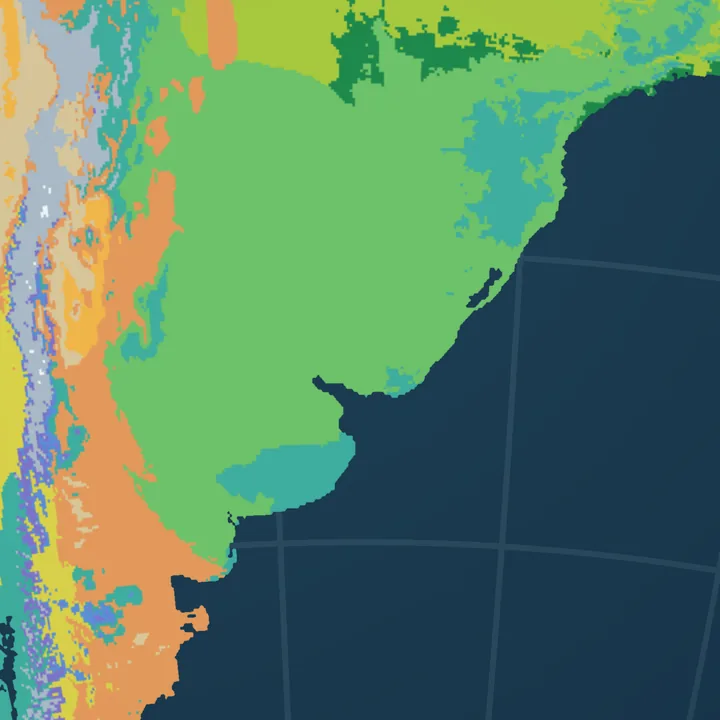
Humid subtropical · 30Oceanic · 1Monthly climate averages for 31 towns in Uruguay, including Montevideo, Salto and Maldonado. Each page has month-by-month temperature, rain and snow, sunshine and more, from modelled 1981–2010 averages for each town’s own location.
Climate types in Uruguay
Towns in Uruguay
Köppen type · year-average temperature · yearly rain and snow (as water), 1981–2010. Grouped by region; largest towns first.
Artigas
Towns: Artigas
Canelones
Towns: Las Piedras · Barros Blancos · Canelones · Pando · La Paz · Santa Lucía · Progreso · Paso de Carrasco
Cerro Largo
Towns: Melo
Colonia
Towns: Colonia del Sacramento · Carmelo
Durazno Department
Towns: Durazno
Flores Department
Towns: Trinidad
Florida
Towns: Florida
Lavalleja
Towns: Minas
Maldonado
Smaller towns: San Carlos
Montevideo Department
Paysandú Department
Towns: Paysandú
Rivera Department
Towns: Rivera
Rocha Department
Towns: Rocha
Río Negro Department
Towns: Fray Bentos · Young
Salto Department
San José Department
Towns: San José de Mayo · Delta del Tigre
Soriano
Tacuarembó Department
Towns: Tacuarembó
Treinta y Tres Department
Towns: Treinta y Tres
Sources: CHELSA V2.1 (1981–2010; temperature, precipitation, wind), ERA5-Land (Copernicus, 1981–2010; dew point, snow; contains modified Copernicus Climate Change Service information), relative humidity calculated from that dew point and the CHELSA night lows and day highs, CRU CL 2.0 (New et al. 2002, about 1961–1990; sunshine and the day–night range), NOAA GHCN-Daily (station normals 1981–2010; temperatures and snowfall adjusted toward nearby stations), GeoNames (town names, populations and heights, CC BY 4.0), climate types by the Köppen–Geiger rules of Peel et al. (2007).