 ClimaClue
Busan vs Ulsan climate
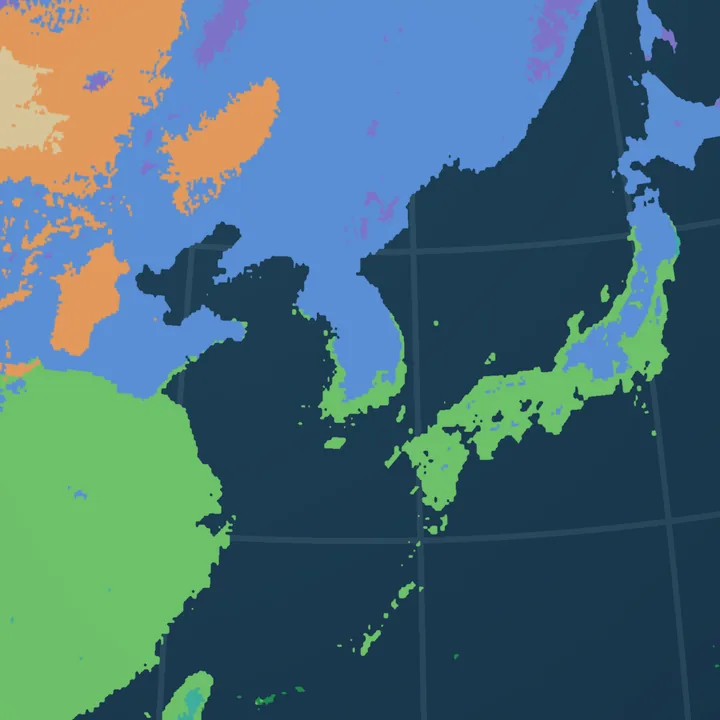
55 km apart
- ABusanSouth Korea · Humid subtropical, dry winter14.9 °Cyear average1,638 mmrain and snow a year
- BUlsanSouth Korea · Humid subtropical, dry winter14.8 °Cyear average1,186 mmrain and snow a year
How the climate of Busan, South Korea compares with Ulsan, South Korea: month-by-month averages from modelled 1981–2010 data for each town’s own location.
Main differences
- Busan is 0.2 °C (0.3 °F) warmer over the year: 14.9 °C against 14.8 °C.
- The biggest monthly difference is in December, when Busan is 1.6 °C warmer (Busan 6.5 °C, Ulsan 4.9 °C).
- Hottest-month day highs: Busan 29.0 °C (August), Ulsan 30.3 °C (August). Coldest-month night lows: Busan -0.1 °C, Ulsan -2.2 °C.
- Busan gets 38% more rain and snow a year: 1,638 mm against 1,186 mm.
- Ulsan gets about 1 more hours of bright sunshine a year (2,290 h against 2,289 h; about 1961–1990).
- Fresh snow in a typical year: Busan 6.1 cm, Ulsan 6.9 cm (ERA5-Land).
Month by month: which is warmer, drier, sunnier
- Warmer: Busan in 7 of 12 months
- Drier: Ulsan in 12 of 12 months
- Sunnier: Busan in 7 of 12 months
Temperature by month
| Month | Busan average | Ulsan average | Busan day high | Ulsan day high | Busan night low | Ulsan night low |
|---|---|---|---|---|---|---|
| January | 4.240 °F | 2.737 °F | 8.447 °F | 7.646 °F | -0.132 °F | -2.228 °F |
| February | 5.742 °F | 4.740 °F | 10.150 °F | 9.649 °F | 1.435 °F | -0.232 °F |
| March | 9.148 °F | 8.648 °F | 13.656 °F | 13.957 °F | 4.740 °F | 3.338 °F |
| April | 13.456 °F | 13.957 °F | 17.764 °F | 19.367 °F | 9.249 °F | 8.447 °F |
| May | 17.063 °F | 18.165 °F | 21.270 °F | 23.674 °F | 12.855 °F | 12.655 °F |
| June | 20.369 °F | 21.571 °F | 23.775 °F | 26.079 °F | 16.862 °F | 17.163 °F |
| July | 24.075 °F | 25.377 °F | 26.980 °F | 29.084 °F | 21.170 °F | 21.571 °F |
| August | 25.878 °F | 26.480 °F | 29.084 °F | 30.387 °F | 22.673 °F | 22.573 °F |
| September | 22.673 °F | 22.472 °F | 26.379 °F | 26.780 °F | 19.066 °F | 18.165 °F |
| October | 17.864 °F | 17.263 °F | 22.272 °F | 22.673 °F | 13.456 °F | 11.853 °F |
| November | 12.054 °F | 10.851 °F | 16.562 °F | 16.161 °F | 7.546 °F | 5.442 °F |
| December | 6.544 °F | 4.941 °F | 11.052 °F | 10.250 °F | 2.136 °F | -0.431 °F |
| Year | 14.959 °F | 14.859 °F | 18.966 °F | 19.667 °F | 10.952 °F | 9.850 °F |
Rain and sunshine by month
| Month | Busan rain and snow | Ulsan rain and snow | Busan sunshine h | Ulsan sunshine h |
|---|---|---|---|---|
| January | 371.4 in | 291.2 in | 190 | 189 |
| February | 532.1 in | 391.5 in | 168 | 168 |
| March | 843.3 in | 582.3 in | 202 | 202 |
| April | 1405.5 in | 853.3 in | 204 | 207 |
| May | 1646.5 in | 1003.9 in | 230 | 235 |
| June | 2319.1 in | 1646.4 in | 187 | 190 |
| July | 34113.4 in | 2238.8 in | 173 | 175 |
| August | 27911.0 in | 2258.9 in | 205 | 199 |
| September | 1766.9 in | 1596.2 in | 169 | 167 |
| October | 612.4 in | 471.8 in | 195 | 193 |
| November | 491.9 in | 381.5 in | 177 | 176 |
| December | 230.9 in | 200.8 in | 190 | 190 |
| Year | 1,63864.5 in | 1,18646.7 in | 2,289 | 2,290 |
Average: monthly mean air temperature, day and night together. Day high and night low: the month’s average daily maximum and minimum. Differences are plain subtractions of these stored averages. Values are model estimates for each town’s own location (sunshine: its ~10 km area), not station measurements.
Other comparisons
- Busan vs ChangwonSouth Korea · 35 km
- Busan vs DaeguSouth Korea · 94 km
- Busan vs FukuokaSouth Korea · Japan · 210 km
- Busan vs KureSouth Korea · Japan · 338 km
- Busan vs TakasakiSouth Korea · Japan · 912 km
- Changwon vs UlsanSouth Korea · 67 km
Sources: CHELSA V2.1 (1981–2010; temperature, precipitation, wind), ERA5-Land (Copernicus, 1981–2010; dew point, snow; contains modified Copernicus Climate Change Service information), relative humidity calculated from that dew point and the CHELSA night lows and day highs, CRU CL 2.0 (New et al. 2002, about 1961–1990; sunshine and the day–night range), NOAA GHCN-Daily (station normals 1981–2010; temperatures and snowfall adjusted toward nearby stations), GeoNames (town names, populations and heights, CC BY 4.0), climate types by the Köppen–Geiger rules of Peel et al. (2007).