 ClimaClue
Daegu vs Daejeon climate
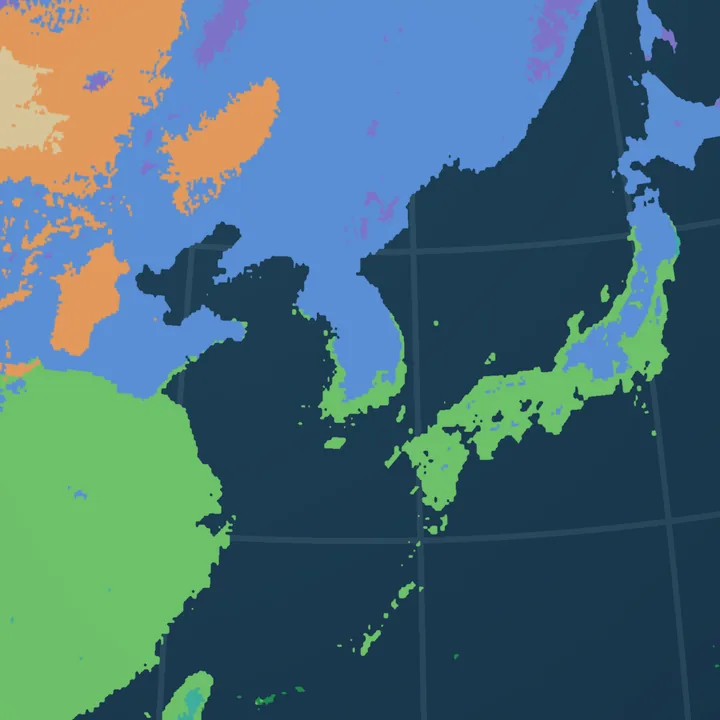
122 km apart
- ADaeguSouth Korea · Humid subtropical, dry winter14.0 °Cyear average979 mmrain and snow a year
- BDaejeonSouth Korea · Continental, hot summer, dry winter13.3 °Cyear average1,223 mmrain and snow a year
How the climate of Daegu, South Korea compares with Daejeon, South Korea: month-by-month averages from modelled 1981–2010 data for each town’s own location.
Main differences
- Daegu is 0.7 °C (1.2 °F) warmer over the year: 14.0 °C against 13.3 °C.
- The biggest monthly difference is in February, when Daegu is 1.3 °C warmer (Daegu 2.8 °C, Daejeon 1.5 °C).
- Hottest-month day highs: Daegu 31.1 °C (August), Daejeon 30.6 °C (August). Coldest-month night lows: Daegu -5.3 °C, Daejeon -6.2 °C.
- Daejeon gets 25% more rain and snow a year: 1,223 mm against 979 mm.
- Daegu gets about 58 more hours of bright sunshine a year (2,483 h against 2,425 h; about 1961–1990).
- Fresh snow in a typical year: Daegu 13 cm, Daejeon 27 cm (ERA5-Land).
Month by month: which is warmer, drier, sunnier
- Warmer: Daegu in 12 of 12 months
- Drier: Daegu in 12 of 12 months
- Sunnier: even, 6 months each
Temperature by month
| Month | Daegu average | Daejeon average | Daegu day high | Daejeon day high | Daegu night low | Daejeon night low |
|---|---|---|---|---|---|---|
| January | 0.333 °F | -0.930 °F | 5.943 °F | 4.340 °F | -5.322 °F | -6.221 °F |
| February | 2.837 °F | 1.535 °F | 8.447 °F | 6.844 °F | -2.927 °F | -3.825 °F |
| March | 7.746 °F | 6.644 °F | 13.957 °F | 12.655 °F | 1.435 °F | 0.533 °F |
| April | 14.358 °F | 13.456 °F | 21.070 °F | 20.168 °F | 7.646 °F | 6.644 °F |
| May | 19.267 °F | 18.666 °F | 26.179 °F | 25.177 °F | 12.454 °F | 12.254 °F |
| June | 23.174 °F | 22.973 °F | 28.784 °F | 28.383 °F | 17.564 °F | 17.664 °F |
| July | 25.979 °F | 25.678 °F | 30.286 °F | 29.785 °F | 21.671 °F | 21.571 °F |
| August | 26.480 °F | 26.179 °F | 31.188 °F | 30.687 °F | 21.871 °F | 21.771 °F |
| September | 21.671 °F | 21.470 °F | 27.081 °F | 26.880 °F | 16.161 °F | 15.961 °F |
| October | 15.560 °F | 14.959 °F | 22.172 °F | 21.571 °F | 8.848 °F | 8.347 °F |
| November | 8.447 °F | 7.746 °F | 14.458 °F | 13.456 °F | 2.336 °F | 2.036 °F |
| December | 2.336 °F | 1.435 °F | 8.147 °F | 6.744 °F | -3.526 °F | -3.925 °F |
| Year | 14.057 °F | 13.356 °F | 19.768 °F | 18.866 °F | 8.247 °F | 7.746 °F |
Rain and sunshine by month
| Month | Daegu rain and snow | Daejeon rain and snow | Daegu sunshine h | Daejeon sunshine h |
|---|---|---|---|---|
| January | 190.7 in | 261.0 in | 200 | 171 |
| February | 261.0 in | 321.3 in | 185 | 170 |
| March | 421.7 in | 481.9 in | 224 | 219 |
| April | 592.3 in | 682.7 in | 228 | 233 |
| May | 752.9 in | 853.4 in | 255 | 261 |
| June | 1315.2 in | 1516.0 in | 217 | 230 |
| July | 2098.2 in | 28811.3 in | 190 | 195 |
| August | 2148.4 in | 27010.6 in | 213 | 219 |
| September | 1315.1 in | 1415.6 in | 188 | 202 |
| October | 311.2 in | 461.8 in | 209 | 209 |
| November | 281.1 in | 431.7 in | 180 | 158 |
| December | 140.5 in | 251.0 in | 193 | 159 |
| Year | 97938.6 in | 1,22348.2 in | 2,483 | 2,425 |
Average: monthly mean air temperature, day and night together. Day high and night low: the month’s average daily maximum and minimum. Differences are plain subtractions of these stored averages. Values are model estimates for each town’s own location (sunshine: its ~10 km area), not station measurements.
Other comparisons
- Bozhou vs DaeguChina · South Korea · 1,190 km
- Busan vs DaeguSouth Korea · 94 km
- Changwon vs DaeguSouth Korea · 72 km
- Chengtangcun vs DaeguChina · South Korea · 1,036 km
- Daegu vs GwangjuSouth Korea · 172 km
- Daegu vs HanzhongSouth Korea · China · 1,998 km
Sources: CHELSA V2.1 (1981–2010; temperature, precipitation, wind), ERA5-Land (Copernicus, 1981–2010; dew point, snow; contains modified Copernicus Climate Change Service information), relative humidity calculated from that dew point and the CHELSA night lows and day highs, CRU CL 2.0 (New et al. 2002, about 1961–1990; sunshine and the day–night range), NOAA GHCN-Daily (station normals 1981–2010; temperatures and snowfall adjusted toward nearby stations), GeoNames (town names, populations and heights, CC BY 4.0), climate types by the Köppen–Geiger rules of Peel et al. (2007).