 ClimaClue
Sunniest Cities in Argentina in February
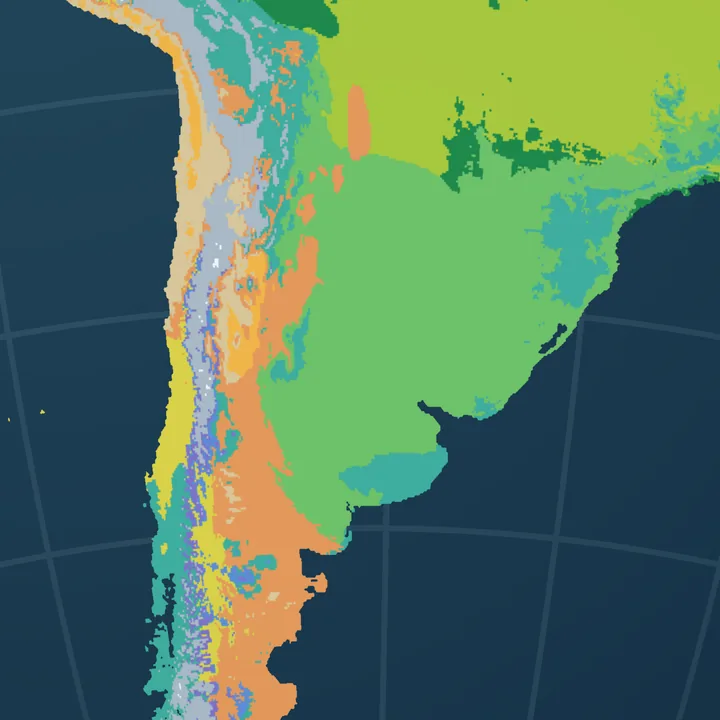
Sunniest in February · top 3
- 1San RafaelMendoza293 h
- 2NeuquénNeuquen290 h
- 3RawsonSan Juan280 h
San Rafael ranks first by hours of bright sunshine in February, with 293 h. The table lists the top 10 of 39 ranked towns in Argentina; values are CRU CL 2.0 sunshine estimates, about 1961–1990 (a different period from the temperatures).
| # | Town | Feb sunshine h | Feb average °C | Feb day high °C | Feb rain and snow mm |
|---|---|---|---|---|---|
| 1 | San RafaelMendoza | 293 | 22.873 °F | 30.687 °F | 572.2 in |
| 2 | NeuquénNeuquen | 290 | 22.572 °F | 30.988 °F | 150.6 in |
| 3 | RawsonSan Juan | 280 | 24.476 °F | 32.190 °F | 170.7 in |
| 4 | San Luis | 275 | 23.174 °F | 30.086 °F | 1616.3 in |
| 5 | Bahía BlancaBuenos Aires | 263 | 22.573 °F | 29.886 °F | 712.8 in |
| 6 | Santa RosaLa Pampa | 260 | 22.372 °F | 29.886 °F | 773.0 in |
| 7 | Mendoza | 256 | 23.374 °F | 29.986 °F | 341.3 in |
| 8 | Catamarca | 253 | 24.777 °F | 31.288 °F | 742.9 in |
| 9 | Río CuartoCordoba | 252 | 21.971 °F | 28.383 °F | 923.6 in |
| 10 | TandilBuenos Aires | 251 | 19.868 °F | 26.980 °F | 993.9 in |
Ranked among the 39 towns of 100,000+ people covered in Argentina (of 45 covered); this is not a complete list of every city. 6 towns sharing a 10 km area with a larger town are counted once, under the larger town, because the numbers are the same.
Values are modelled averages for each town’s own location (the ~3 km around its centre; sunshine, dew point and snow: the ~10 km area around it), not station measurements; ranking is a plain sort of the stored values (ties: larger town first).
Sunniest Cities in Argentina in: Jan · Feb · Mar · Apr · May · Jun · Jul · Aug · Sep · Oct · Nov · Dec
Wider rankings: Sunniest Cities in the World in February · Sunniest Cities in South America in February
More rankings in Argentina: warmest · coldest · sunniest · cloudiest · wettest · driest · most humid · hottest summers · mildest winters · warmest sea · all rankings · all towns in Argentina
Sources: CHELSA V2.1 (1981–2010; temperature, precipitation, wind), ERA5-Land (Copernicus, 1981–2010; dew point, snow; contains modified Copernicus Climate Change Service information), relative humidity calculated from that dew point and the CHELSA night lows and day highs, CRU CL 2.0 (New et al. 2002, about 1961–1990; sunshine and the day–night range), NOAA GHCN-Daily (station normals 1981–2010; temperatures and snowfall adjusted toward nearby stations), GeoNames (town names, populations and heights, CC BY 4.0), climate types by the Köppen–Geiger rules of Peel et al. (2007).