 ClimaClue
Wettest Cities in Argentina in May
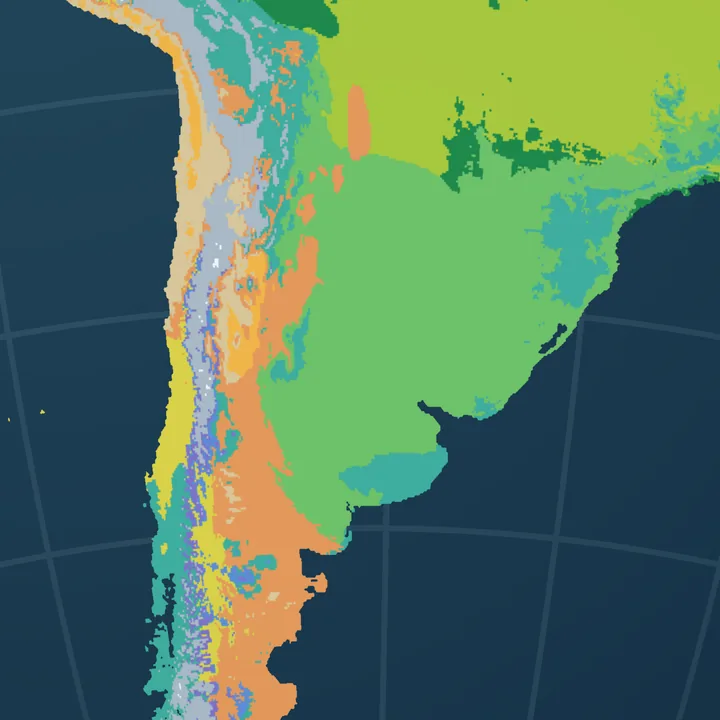
Posadas ranks first by precipitation in May (rain and snow as water), with 149 mm. The table lists the top 10 of 39 ranked towns in Argentina; values are CHELSA V2.1 monthly averages, 1981–2010.
| # | Town | May rain and snow mm | May average °C | May day high °C | May sunshine h |
|---|---|---|---|---|---|
| 1 | PosadasMisiones | 1495.9 in | 17.964 °F | 23.474 °F | 165 |
| 2 | ItuzaingóCorrientes | 1435.6 in | 18.465 °F | 23.875 °F | 176 |
| 3 | Formosa | 1014.0 in | 18.966 °F | 23.775 °F | 193 |
| 4 | ConcordiaEntre Rios | 1003.9 in | 15.359 °F | 20.869 °F | 177 |
| 5 | Buenos AiresBuenos Aires F.D. | 943.7 in | 14.859 °F | 19.066 °F | 163 |
| 6 | José C. PazBuenos Aires | 893.5 in | 13.656 °F | 18.966 °F | 176 |
| 7 | La PlataBuenos Aires | 893.5 in | 13.757 °F | 18.465 °F | 155 |
| 8 | Corrientes | 883.5 in | 18.265 °F | 23.474 °F | 197 |
| 9 | CastelarBuenos Aires | 873.4 in | 14.057 °F | 18.966 °F | 172 |
| 10 | Isidro CasanovaBuenos Aires | 873.4 in | 13.957 °F | 19.267 °F | 171 |
Ranked among the 39 towns of 100,000+ people covered in Argentina (of 45 covered); this is not a complete list of every city. 6 towns sharing a 10 km area with a larger town are counted once, under the larger town, because the numbers are the same.
Values are modelled averages for each town’s own location (the ~3 km around its centre; sunshine, dew point and snow: the ~10 km area around it), not station measurements; ranking is a plain sort of the stored values (ties: larger town first). Sunshine: CRU CL 2.0, about 1961–1990.
Wettest Cities in Argentina in: Jan · Feb · Mar · Apr · May · Jun · Jul · Aug · Sep · Oct · Nov · Dec
Wider rankings: Wettest Cities in the World in May · Wettest Cities in South America in May
More rankings in Argentina: warmest · coldest · sunniest · cloudiest · wettest · driest · most humid · hottest summers · mildest winters · warmest sea · all rankings · all towns in Argentina
Sources: CHELSA V2.1 (1981–2010; temperature, precipitation, wind), ERA5-Land (Copernicus, 1981–2010; dew point, snow; contains modified Copernicus Climate Change Service information), relative humidity calculated from that dew point and the CHELSA night lows and day highs, CRU CL 2.0 (New et al. 2002, about 1961–1990; sunshine and the day–night range), NOAA GHCN-Daily (station normals 1981–2010; temperatures and snowfall adjusted toward nearby stations), GeoNames (town names, populations and heights, CC BY 4.0), climate types by the Köppen–Geiger rules of Peel et al. (2007).