 ClimaClue
Hot desert climate (Köppen BWh)
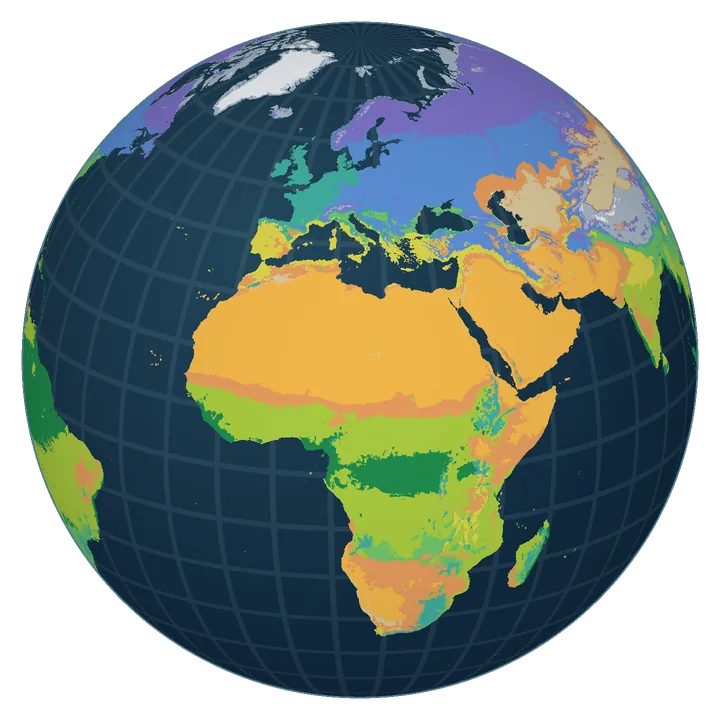
Köppen BWh
Hot desert- 1,313towns
- 50countries
- 33.5 °Ctypical warmest month
- 14.6 °Ctypical coolest month
Very dry and hot: far more water could evaporate than ever falls.
- Very little rain in any month
- Scorching summers and mild to warm winters
- Clear skies and big swings between day and night
Where the hot desert climate occurs
1,313 of ClimaClue’s towns have this type, in 50 countries. Across them, the median warmest month averages 33.5 °C (92 °F), the median coolest month 14.6 °C (58 °F), and the median yearly precipitation is 131 mm (5.1 in).
Types are calculated from each town’s own modelled 1981–2010 monthly averages, with the Köppen–Geiger rules of Peel et al. (2007).
What typically causes this climate
Textbook mechanisms that typically produce this type; any one place can differ.
- Temperature
- Clear, dry air lets the ground heat strongly by day and lose heat quickly at night, so swings are large.
- Rain and snow
- Sinking air in the subtropical high-pressure belt, distance from moist air, or mountains blocking it keeps rain rare.
- Sunshine and cloud
- Sinking dry air suppresses clouds, so sunshine is abundant.
- Moisture
- Little water is available to evaporate, so dew points are low and humidity drops sharply in the afternoon heat.
- Wind
- Strong daytime heating can stir gusty winds and dust.
Themes: Desert cities · climate rankings
Countries with this climate type
- Egypt235 towns with this climate
- Pakistan183 towns with this climate
- Saudi Arabia87 towns with this climate
- Peru64 towns with this climate
- Iran63 towns with this climate
- United States61 towns with this climate
- Iraq58 towns with this climate
- India50 towns with this climate
- Sudan49 towns with this climate
- Algeria44 towns with this climate
- United Arab Emirates31 towns with this climate
- Niger30 towns with this climate
- Mexico28 towns with this climate
- Oman27 towns with this climate
- Mauritania24 towns with this climate
- Tunisia21 towns with this climate
- Ethiopia20 towns with this climate
- Libya19 towns with this climate
- Morocco19 towns with this climate
- Somalia19 towns with this climate
- Senegal17 towns with this climate
- Yemen15 towns with this climate
- Chad13 towns with this climate
- Kuwait13 towns with this climate
- Mali11 towns with this climate
- Qatar10 towns with this climate
- Spain10 towns with this climate
- Angola8 towns with this climate
- Bahrain8 towns with this climate
- Djibouti7 towns with this climate
- Nigeria7 towns with this climate
- Syria7 towns with this climate
- Afghanistan6 towns with this climate
- Kenya5 towns with this climate
- Namibia5 towns with this climate
- Australia4 towns with this climate
- Cabo Verde4 towns with this climate
- Chile4 towns with this climate
- Jordan4 towns with this climate
- Venezuela4 towns with this climate
- Western Sahara4 towns with this climate
- Eritrea3 towns with this climate
- Turkmenistan3 towns with this climate
- Argentina2 towns with this climate
- South Africa2 towns with this climate
- Botswana1 town with this climate
- Cameroon1 town with this climate
- Israel1 town with this climate
- Uzbekistan1 town with this climate
- Zimbabwe1 town with this climate
The 120 largest towns with this climate
- KarachiPakistan · 180 mm a year26.1 °C
- CairoEgypt · 20 mm a year21.9 °C
- LimaPeru · 38 mm a year19.0 °C
- BaghdadIraq · 160 mm a year25.2 °C
- AlexandriaEgypt · 196 mm a year20.4 °C
- JeddahSaudi Arabia · 69 mm a year28.1 °C
- GizaEgypt · 18 mm a year22.1 °C
- RiyadhSaudi Arabia · 103 mm a year26.5 °C
- DubaiUnited Arab Emirates · 113 mm a year27.7 °C
- MultanPakistan · 230 mm a year26.0 °C
- KhartoumSudan · 107 mm a year29.6 °C
- SanaaYemen · 231 mm a year18.2 °C
- HyderabadPakistan · 170 mm a year26.9 °C
- OmdurmanSudan · 99 mm a year29.4 °C
- Abu DhabiUnited Arab Emirates · 71 mm a year27.6 °C
- SharjahUnited Arab Emirates · 118 mm a year27.5 °C
- PhoenixUnited States · 217 mm a year23.1 °C
- MakkahSaudi Arabia · 129 mm a year29.2 °C
- Ciudad JuárezMexico · 246 mm a year18.5 °C
- BasrahIraq · 151 mm a year26.9 °C
- MadinahSaudi Arabia · 63 mm a year28.2 °C
- DammamSaudi Arabia · 90 mm a year26.1 °C
- Shubrā al KhaymahEgypt · 20 mm a year21.8 °C
- CallaoPeru · 21 mm a year18.5 °C
- KarbalaIraq · 108 mm a year24.8 °C
- Sadr CityIraq · 167 mm a year25.3 °C
- NouakchottMauritania · 66 mm a year25.2 °C
- AdenYemen · 85 mm a year27.5 °C
- TrujilloPeru · 76 mm a year19.7 °C
- Jodhpur, RajasthanIndia · 375 mm a year26.5 °C
- MexicaliMexico · 78 mm a year23.7 °C
- Khartoum NorthSudan · 101 mm a year29.5 °C
- SulţānahSaudi Arabia · 63 mm a year28.2 °C
- BahawalpurPakistan · 175 mm a year26.0 °C
- QomIran · 151 mm a year19.5 °C
- Abū GhuraybIraq · 140 mm a year25.0 °C
- ArifwalaPakistan · 297 mm a year25.6 °C
- Al Ain CityUnited Arab Emirates · 98 mm a year28.0 °C
- AhvazIran · 232 mm a year26.3 °C
- HermosilloMexico · 342 mm a year24.3 °C
- MuscatOman · 88 mm a year28.6 °C
- Port SaidEgypt · 84 mm a year20.7 °C
- Dera Ismail KhanPakistan · 363 mm a year25.3 °C
- BuraydahSaudi Arabia · 150 mm a year25.4 °C
- TorreónMexico · 262 mm a year22.0 °C
- Al ḨudaydahYemen · 115 mm a year30.1 °C
- SuezEgypt · 19 mm a year22.2 °C
- Ta’ifSaudi Arabia · 238 mm a year21.9 °C
- El PasoUnited States · 234 mm a year18.4 °C
- TabukSaudi Arabia · 26 mm a year21.6 °C
- BikanerIndia · 263 mm a year26.8 °C
- Las VegasUnited States · 136 mm a year20.6 °C
- Al AḩmadīKuwait · 120 mm a year25.9 °C
- PiuraPeru · 183 mm a year24.0 °C
- DjiboutiDjibouti · 229 mm a year28.9 °C
- Al MansurahEgypt · 53 mm a year21.2 °C
- ChiclayoPeru · 68 mm a year21.8 °C
- Jhang SadrPakistan · 362 mm a year25.5 °C
- Ha'ilSaudi Arabia · 116 mm a year21.9 °C
- MukallaYemen · 109 mm a year27.7 °C
- Al Maḩallah al KubráEgypt · 52 mm a year21.2 °C
- TantaEgypt · 44 mm a year21.3 °C
- NyalaSudan · 374 mm a year26.8 °C
- SukkurPakistan · 112 mm a year27.4 °C
- NasiriyahIraq · 119 mm a year26.7 °C
- BenguelaAngola · 293 mm a year24.1 °C
- BalbalaDjibouti · 244 mm a year28.7 °C
- ZahedanIran · 85 mm a year19.0 °C
- Sahiwal, Punjab (30.7°N 73.1°E)Pakistan · 333 mm a year25.4 °C
- OkaraPakistan · 382 mm a year25.1 °C
- Ar RaqqahSyria · 186 mm a year20.0 °C
- AssiutEgypt · 4 mm a year23.9 °C
- Al FayyumEgypt · 10 mm a year22.7 °C
- Rahim Yar KhanPakistan · 130 mm a year26.6 °C
- NajrānSaudi Arabia · 77 mm a year25.1 °C
- Jalalpur PirwalaPakistan · 183 mm a year26.0 °C
- Dera Ghazi KhanPakistan · 256 mm a year26.3 °C
- AjmanUnited Arab Emirates · 124 mm a year27.4 °C
- Port SudanSudan · 58 mm a year28.4 °C
- Al KhuşūşEgypt · 21 mm a year21.8 °C
- NajafIraq · 112 mm a year24.9 °C
- YazdIran · 81 mm a year20.2 °C
- HargeysaSomalia · 346 mm a year21.8 °C
- MesaUnited States · 223 mm a year22.8 °C
- SeebOman · 78 mm a year27.8 °C
- EsnaEgypt · 2 mm a year26.0 °C
- Al HillahIraq · 117 mm a year25.5 °C
- WarderEthiopia · 250 mm a year26.6 °C
- ZagazigEgypt · 31 mm a year21.5 °C
- IsmailiaEgypt · 32 mm a year21.4 °C
- Tando BagoPakistan · 238 mm a year26.9 °C
- Al KharjSaudi Arabia · 79 mm a year26.8 °C
- LuxorEgypt · 3 mm a year25.4 °C
- Tando AllahyarPakistan · 182 mm a year26.7 °C
- Kom OmboEgypt · 2 mm a year26.9 °C
- KassalaSudan · 250 mm a year29.3 °C
- El ObeidSudan · 346 mm a year27.1 °C
- Khamis MushaitSaudi Arabia · 264 mm a year19.8 °C
- WindhoekNamibia · 309 mm a year20.3 °C
- BawsharOman · 90 mm a year28.6 °C
- AswānEgypt · 2 mm a year27.2 °C
- 6th of October CityEgypt · 15 mm a year21.8 °C
- LarkanaPakistan · 120 mm a year27.6 °C
- NawabshahPakistan · 146 mm a year27.3 °C
- MaradiNiger · 409 mm a year27.7 °C
- BurewalaPakistan · 259 mm a year25.7 °C
- Abū al-KahṣībIraq · 153 mm a year26.8 °C
- SinjhoroPakistan · 161 mm a year27.0 °C
- Bandar AbbasIran · 182 mm a year27.4 °C
- Ras Al KhaimahUnited Arab Emirates · 147 mm a year28.1 °C
- KostiSudan · 311 mm a year29.2 °C
- DohaQatar · 86 mm a year27.1 °C
- Wad MedaniSudan · 277 mm a year30.0 °C
- KhorramshahrIran · 164 mm a year26.8 °C
- GuédiawayeSenegal · 380 mm a year24.3 °C
- Al ‘AmārahIraq · 182 mm a year26.5 °C
- ZinderNiger · 345 mm a year27.5 °C
- Al DiwaniyahIraq · 115 mm a year26.2 °C
- DamanhurEgypt · 88 mm a year20.7 °C
- ChimbotePeru · 28 mm a year19.4 °C
Sources: CHELSA V2.1 (1981–2010; temperature, precipitation, wind), ERA5-Land (Copernicus, 1981–2010; dew point, snow; contains modified Copernicus Climate Change Service information), relative humidity calculated from that dew point and the CHELSA night lows and day highs, CRU CL 2.0 (New et al. 2002, about 1961–1990; sunshine and the day–night range), NOAA GHCN-Daily (station normals 1981–2010; temperatures and snowfall adjusted toward nearby stations), GeoNames (town names, populations and heights, CC BY 4.0), climate types by the Köppen–Geiger rules of Peel et al. (2007).