 ClimaClue
Humid continental, warm summer climate (Köppen Dfb)
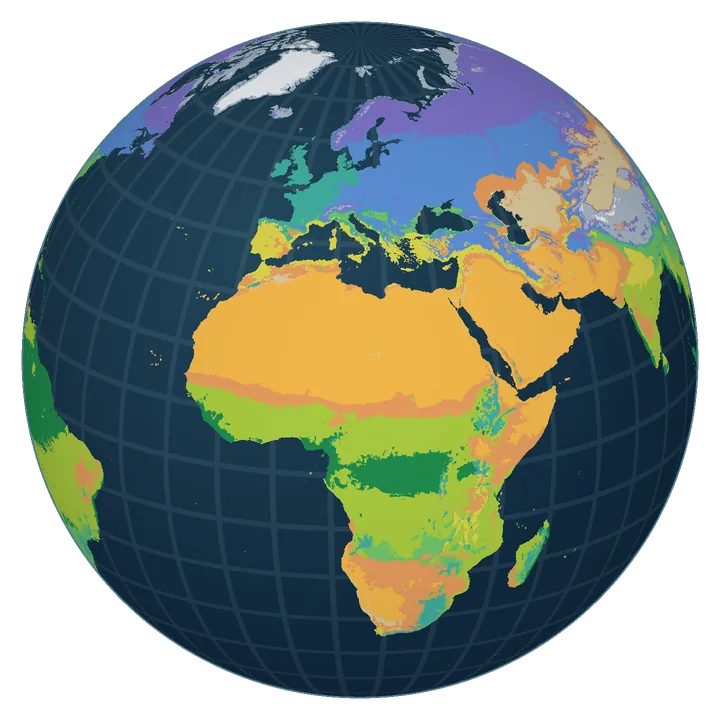
Köppen Dfb
Humid continental, warm summer- 2,550towns
- 41countries
- 19.2 °Ctypical warmest month
- -4.0 °Ctypical coolest month
Warm summers and cold, snowy winters, with rain or snow all year.
- No dry season
- Warm summers
- Long, cold winters with lasting snow
Where the humid continental, warm summer climate occurs
2,550 of ClimaClue’s towns have this type, in 41 countries. Across them, the median warmest month averages 19.2 °C (66 °F), the median coolest month -4.0 °C (25 °F), and the median yearly precipitation is 674 mm (26.5 in).
Types are calculated from each town’s own modelled 1981–2010 monthly averages, with the Köppen–Geiger rules of Peel et al. (2007).
What typically causes this climate
Textbook mechanisms that typically produce this type; any one place can differ.
- Temperature
- Inland from the sea, land loses heat in winter and warms quickly in summer, so seasons are strongly contrasted.
- Rain and snow
- Storm systems bring precipitation year-round: rain in summer, snow in winter.
- Sunshine and cloud
- Cloudiness follows passing storms; long summer days can still bring plenty of sunshine.
- Moisture
- Cold winter air holds little water vapour; summer dew points are much higher.
- Wind
- Storm tracks bring windier weather in the cold season.
Themes: Cities with four distinct seasons · climate rankings
Countries with this climate type
- Russia648 towns with this climate
- Poland342 towns with this climate
- Canada244 towns with this climate
- United States215 towns with this climate
- Ukraine201 towns with this climate
- Germany191 towns with this climate
- Czechia87 towns with this climate
- Sweden81 towns with this climate
- Romania75 towns with this climate
- Slovakia59 towns with this climate
- Belarus57 towns with this climate
- Japan53 towns with this climate
- Finland47 towns with this climate
- Hungary41 towns with this climate
- Kazakhstan29 towns with this climate
- Norway23 towns with this climate
- Austria20 towns with this climate
- Lithuania20 towns with this climate
- Latvia13 towns with this climate
- Moldova12 towns with this climate
- Turkey12 towns with this climate
- Switzerland11 towns with this climate
- Armenia9 towns with this climate
- India8 towns with this climate
- Estonia7 towns with this climate
- Bulgaria6 towns with this climate
- Slovenia6 towns with this climate
- Bosnia and Herzegovina5 towns with this climate
- Georgia4 towns with this climate
- Azerbaijan3 towns with this climate
- China3 towns with this climate
- France3 towns with this climate
- Kyrgyzstan3 towns with this climate
- Serbia3 towns with this climate
- Iran2 towns with this climate
- Pakistan2 towns with this climate
- Aland Islands1 town with this climate
- Italy1 town with this climate
- Kosovo1 town with this climate
- Liechtenstein1 town with this climate
- Montenegro1 town with this climate
The 120 largest towns with this climate
- MoscowRussia · 691 mm a year5.8 °C
- Saint PetersburgRussia · 690 mm a year5.8 °C
- KyivUkraine · 632 mm a year8.3 °C
- TorontoCanada · 875 mm a year8.7 °C
- SapporoJapan · 1,573 mm a year8.3 °C
- MontréalCanada · 1,207 mm a year6.5 °C
- MinskBelarus · 686 mm a year6.7 °C
- WarsawPoland · 582 mm a year8.5 °C
- NovosibirskRussia · 463 mm a year1.9 °C
- AstanaKazakhstan · 334 mm a year3.5 °C
- StockholmSweden · 587 mm a year7.2 °C
- MunichGermany · 1,006 mm a year8.8 °C
- YekaterinburgRussia · 546 mm a year3.2 °C
- KharkivUkraine · 526 mm a year8.1 °C
- CalgaryCanada · 441 mm a year4.8 °C
- Nizhniy NovgorodRussia · 697 mm a year5.3 °C
- KazanRussia · 536 mm a year4.9 °C
- ChelyabinskRussia · 460 mm a year3.1 °C
- OmskRussia · 391 mm a year2.4 °C
- SamaraRussia · 510 mm a year6.1 °C
- SofiaBulgaria · 612 mm a year11.1 °C
- UfaRussia · 684 mm a year3.7 °C
- KrasnoyarskRussia · 451 mm a year2.2 °C
- OsloNorway · 922 mm a year7.2 °C
- VoronezhRussia · 637 mm a year7.1 °C
- OttawaCanada · 960 mm a year6.4 °C
- EdmontonCanada · 448 mm a year3.7 °C
- PermRussia · 689 mm a year2.9 °C
- DonetskUkraine · 537 mm a year8.5 °C
- KrakówPoland · 689 mm a year8.9 °C
- TyumenRussia · 498 mm a year2.4 °C
- ErzurumTurkey · 515 mm a year6.1 °C
- WinnipegCanada · 563 mm a year3.4 °C
- RigaLatvia · 727 mm a year7.1 °C
- MississaugaCanada · 936 mm a year8.3 °C
- LvivUkraine · 754 mm a year8.0 °C
- TolyattiRussia · 564 mm a year5.3 °C
- SarajevoBosnia and Herzegovina · 976 mm a year9.9 °C
- WrocławPoland · 576 mm a year9.4 °C
- HelsinkiFinland · 674 mm a year5.6 °C
- BramptonCanada · 877 mm a year7.8 °C
- IzhevskRussia · 512 mm a year3.4 °C
- ŁódźPoland · 618 mm a year8.3 °C
- BarnaulRussia · 485 mm a year2.9 °C
- UlyanovskRussia · 544 mm a year4.8 °C
- YaroslavlRussia · 618 mm a year4.5 °C
- GothenburgSweden · 937 mm a year7.9 °C
- TomskRussia · 705 mm a year1.1 °C
- HamiltonCanada · 969 mm a year9.0 °C
- KemerovoRussia · 551 mm a year1.7 °C
- VilniusLithuania · 691 mm a year6.9 °C
- NovokuznetskRussia · 536 mm a year2.7 °C
- Ryazan’Russia · 618 mm a year5.8 °C
- PoznańPoland · 537 mm a year9.0 °C
- QuébecCanada · 1,174 mm a year5.0 °C
- PenzaRussia · 578 mm a year5.6 °C
- NurembergGermany · 752 mm a year9.3 °C
- Naberezhnyye ChelnyRussia · 542 mm a year4.3 °C
- LipetskRussia · 578 mm a year6.3 °C
- Kirov, Kirov OblastRussia · 711 mm a year3.2 °C
- Homyel'Belarus · 660 mm a year7.1 °C
- KaragandyKazakhstan · 349 mm a year4.0 °C
- CheboksaryRussia · 544 mm a year4.5 °C
- GdańskPoland · 571 mm a year8.4 °C
- TulaRussia · 607 mm a year5.6 °C
- KaliningradRussia · 803 mm a year8.2 °C
- HalifaxCanada · 1,487 mm a year7.0 °C
- KurskRussia · 670 mm a year6.9 °C
- LavalCanada · 1,051 mm a year6.7 °C
- StavropolRussia · 733 mm a year9.5 °C
- VinnytsyaUkraine · 626 mm a year8.0 °C
- BryanskRussia · 715 mm a year6.1 °C
- BratislavaSlovakia · 620 mm a year10.6 °C
- LondonCanada · 1,007 mm a year8.1 °C
- TverRussia · 685 mm a year5.2 °C
- MagnitogorskRussia · 396 mm a year3.2 °C
- IvanovoRussia · 625 mm a year4.5 °C
- BrnoCzechia · 500 mm a year9.7 °C
- SzczecinPoland · 565 mm a year9.1 °C
- TallinnEstonia · 685 mm a year6.0 °C
- Nizhny TagilRussia · 520 mm a year2.1 °C
- EtobicokeCanada · 886 mm a year8.4 °C
- HrodnaBelarus · 601 mm a year7.4 °C
- VitebskBelarus · 728 mm a year6.1 °C
- VladimirRussia · 655 mm a year4.9 °C
- MahilyowBelarus · 640 mm a year6.3 °C
- BrestBelarus · 584 mm a year8.3 °C
- BelgorodRussia · 582 mm a year7.5 °C
- KalugaRussia · 647 mm a year5.4 °C
- MakiyivkaUkraine · 563 mm a year8.5 °C
- MarkhamCanada · 902 mm a year7.9 °C
- LublinPoland · 581 mm a year8.3 °C
- AsahikawaJapan · 1,269 mm a year7.4 °C
- BydgoszczPoland · 517 mm a year8.6 °C
- SmolenskRussia · 745 mm a year5.6 °C
- PavlodarKazakhstan · 304 mm a year3.6 °C
- EspooFinland · 735 mm a year5.5 °C
- VaughanCanada · 852 mm a year7.9 °C
- Ust-KamenogorskKazakhstan · 472 mm a year4.2 °C
- SaranskRussia · 564 mm a year4.9 °C
- CherepovetsRussia · 716 mm a year3.9 °C
- VologdaRussia · 595 mm a year3.5 °C
- KurganRussia · 395 mm a year3.0 °C
- VladikavkazRussia · 1,149 mm a year9.7 °C
- OrëlRussia · 645 mm a year6.2 °C
- GrazAustria · 834 mm a year10.5 °C
- AugsburgGermany · 888 mm a year8.7 °C
- GatineauCanada · 948 mm a year6.3 °C
- BiałystokPoland · 599 mm a year7.6 °C
- TambovRussia · 544 mm a year6.3 °C
- SemeyKazakhstan · 278 mm a year4.5 °C
- KaunasLithuania · 651 mm a year7.4 °C
- KatowicePoland · 777 mm a year8.7 °C
- Cluj-NapocaRomania · 592 mm a year9.3 °C
- ChernihivUkraine · 634 mm a year7.5 °C
- OstravaCzechia · 739 mm a year9.3 °C
- PoltavaUkraine · 639 mm a year8.3 °C
- KostromaRussia · 621 mm a year4.5 °C
- HakodateJapan · 1,237 mm a year8.3 °C
- KhmelnytskyiUkraine · 642 mm a year7.9 °C
Sources: CHELSA V2.1 (1981–2010; temperature, precipitation, wind), ERA5-Land (Copernicus, 1981–2010; dew point, snow; contains modified Copernicus Climate Change Service information), relative humidity calculated from that dew point and the CHELSA night lows and day highs, CRU CL 2.0 (New et al. 2002, about 1961–1990; sunshine and the day–night range), NOAA GHCN-Daily (station normals 1981–2010; temperatures and snowfall adjusted toward nearby stations), GeoNames (town names, populations and heights, CC BY 4.0), climate types by the Köppen–Geiger rules of Peel et al. (2007).