 ClimaClue
Jhūsi weather by month and climate
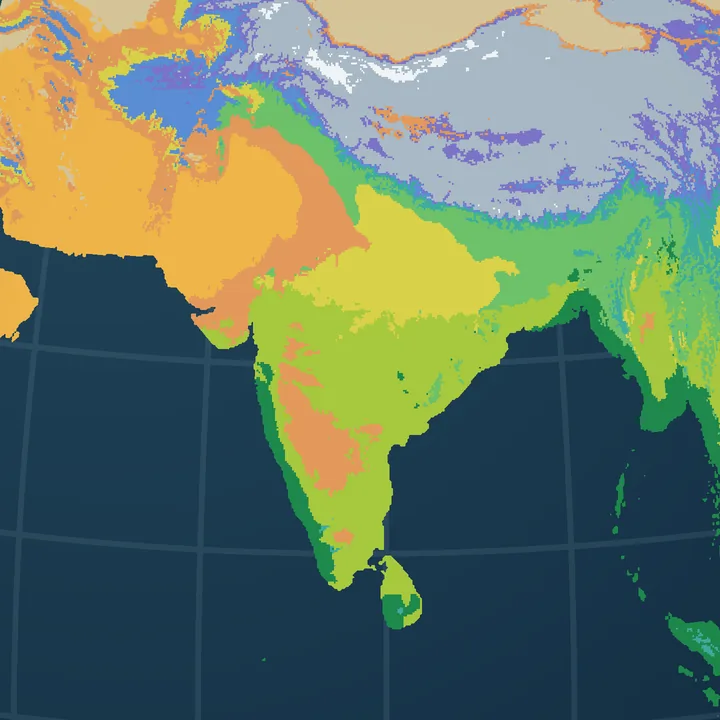
Uttar Pradesh · India
Average temperature, rain and snow, sunshine and more for every month in Jhūsi, from modelled 1981–2010 averages for the town itself (about 3 × 3 km around its centre).
Mediterranean, hot summer · CsaOpen Jhūsi on the globe ›Jhūsi is warmest in May, with 41.3 °C (106 °F) days and 25.8 °C nights, and coolest in January, with 23.0 °C (73 °F) days and 8.1 °C nights. Most rain falls around August (286 mm); April is driest (4 mm).
- Day to day
- ±2.1 °Ca typical day’s swing from its month’s normal; most changeable in June (±3.1 °C)
- Year to year
- ±1.7 °Chow much a month’s average varies between years, most in June; least ±0.5 °C in August
- Record high
- 48.4 °C119 °F, 1994 · Allahabad station, 17 km away
- Record low
- 0.0 °C32 °F, 1975 · Allahabad station, 17 km away
- Best months
- Jan, Feb, Mar, Nov, Decmild and not too wet · where else is warm in January
- Year average25.7 °C78 °F
- Warmest · May33.6 °C92 °F
- Coolest · January15.6 °C60 °F
- Rain and snow a year908 mm35.7 in
- Sunshine a year2,657 habout 1961–1990
Climate type: Mediterranean, hot summer (Köppen Csa) · about this type
Hot, dry summers and mild, wetter winters.
Jhūsi at a glance
Among the 3743 towns ClimaClue covers in India, Jhūsi is 2171st warmest (25.7 °C year average), 1757th sunniest (about 2,657 hours of sunshine a year) and 2443rd wettest (908 mm a year), near the middle on each. Compared with Prayagraj, the nearest covered town with different numbers (6 km away), Jhūsi is 0.1 °C warmer in May and about as warm in January, with 8 mm less precipitation a year. Its warmest month, May (33.6 °C), averages 18.0 °C more than its coolest, January (15.6 °C). Even the coolest nights average 8.1 °C (47 °F), in January. The area lies about 692 km from the sea (deep inland).
Station check: no NOAA GHCN-Daily station with 1981–2010 averages lies within 25 km of Jhūsi, so these modelled values have not been compared with a nearby station.
Temperature and precipitation by month in Jhūsi
Charts: ClimaClue area averages, CHELSA V2.1, 1981–2010. Hover or tap a point or bar for its value; every number is in the table below.
| Month | Average °C | Day high °C | Night low °C | Precipitation mm |
|---|---|---|---|---|
| January | 15.660 °F | 23.073 °F | 8.147 °F | 170.7 in |
| February | 19.166 °F | 27.081 °F | 11.252 °F | 180.7 in |
| March | 24.877 °F | 33.592 °F | 16.161 °F | 90.4 in |
| April | 30.687 °F | 39.1102 °F | 22.072 °F | 40.2 in |
| May | 33.692 °F | 41.3106 °F | 25.878 °F | 100.4 in |
| June | 33.292 °F | 39.2103 °F | 27.281 °F | 893.5 in |
| July | 29.986 °F | 34.093 °F | 25.979 °F | 26110.3 in |
| August | 29.285 °F | 32.791 °F | 25.678 °F | 28611.3 in |
| September | 28.583 °F | 33.192 °F | 23.975 °F | 1756.9 in |
| October | 26.179 °F | 32.691 °F | 19.667 °F | 261.0 in |
| November | 21.270 °F | 29.084 °F | 13.556 °F | 60.2 in |
| December | 16.862 °F | 24.576 °F | 9.148 °F | 60.2 in |
| Year | 25.778 °F | 32.490 °F | 19.066 °F | 90835.7 in |
Average: monthly mean air temperature, day and night together. Day high and night low: the month's average daily maximum and minimum (the CHELSA average plus and minus half the day–night range of CRU CL 2.0), not the hottest or coldest days. Precipitation: monthly total of rain and snow as water.
Sunshine, wind and humidity in Jhūsi
| Month | Sunshine hours | Wind m/s | Humidity % | Dew point °C |
|---|---|---|---|---|
| January | 221 | 2.04.5 mph | 71 | 9.649 °F |
| February | 233 | 2.35.1 mph | 66 | 10.551 °F |
| March | 258 | 2.55.6 mph | 48 | 11.052 °F |
| April | 272 | 2.65.8 mph | 34 | 11.152 °F |
| May | 275 | 2.76.0 mph | 39 | 16.361 °F |
| June | 194 | 2.76.0 mph | 54 | 21.571 °F |
| July | 134 | 2.65.8 mph | 76 | 24.877 °F |
| August | 166 | 2.55.6 mph | 80 | 25.077 °F |
| September | 173 | 2.24.9 mph | 80 | 24.276 °F |
| October | 247 | 1.73.8 mph | 72 | 19.467 °F |
| November | 246 | 1.84.0 mph | 69 | 13.556 °F |
| December | 237 | 1.94.3 mph | 70 | 10.351 °F |
| Year | 2,657 | 2.35.1 mph | 63 | 16.462 °F |
Sunshine: estimated hours of bright sunshine (not daylight length or solar energy); the source gives a percentage of possible daylight, converted to hours with astronomical day length; yearly total. Wind: monthly mean speed about 10 m above the ground; gusts and direction are not shown. Humidity: relative humidity, calculated from the month’s average dew point and its average night low and day high (an estimate, not a measurement). Dew point: how much water vapour the air holds. Year row: totals for sunshine and snow, averages otherwise.
Best time to visit Jhūsi
For mild weather, the best months to visit Jhūsi are January, February, March, November and December.
- Mild (average temperature 15–25 °C / 59–77 °F and under 100 mm / 3.9 in of precipitation): January, February, March, November and December.
- Warmest (average temperature): May (33.6 °C), June (33.2 °C) and April (30.6 °C).
- Driest (least precipitation): April (4 mm), November (6 mm) and December (6 mm).
- Sunniest (hours of sunshine, about 1961–1990): May (275 h), April (272 h) and March (258 h).
Climate only: these rules use 1981–2010 monthly averages and do not consider crowds, prices, events or holidays; any one year can differ.
Jhūsi weather month by month
Average conditions for each month (1981–2010 monthly averages; sunshine about 1961–1990), not forecasts.
Jhūsi weather in January
Day high 23.0 °C (73 °F) · night low 8.1 °C (47 °F) · average 15.6 °C · precipitation 17 mm (0.7 in) · sunshine about 221 hours · humidity 71% · dew point 9.6 °C.
Compared with December: 1.3 °C cooler, 11 mm more precipitation and 16 hours less sunshine.
Jhūsi weather in February
Day high 27.0 °C (81 °F) · night low 11.2 °C (52 °F) · average 19.1 °C · precipitation 18 mm (0.7 in) · sunshine about 233 hours · humidity 66% · dew point 10.5 °C.
Compared with January: 3.5 °C warmer, 1 mm more precipitation and 12 hours more sunshine.
Jhūsi weather in March
Day high 33.5 °C (92 °F) · night low 16.1 °C (61 °F) · average 24.8 °C · precipitation 9 mm (0.4 in) · sunshine about 258 hours · humidity 48% · dew point 11.0 °C.
Compared with February: 5.7 °C warmer, 9 mm less precipitation and 24 hours more sunshine.
Jhūsi weather in April
Day high 39.1 °C (102 °F) · night low 22.0 °C (72 °F) · average 30.6 °C · precipitation 4 mm (0.2 in) · sunshine about 272 hours · humidity 34% · dew point 11.1 °C.
Compared with March: 5.8 °C warmer, 5 mm less precipitation and 15 hours more sunshine.
Jhūsi weather in May
Day high 41.3 °C (106 °F) · night low 25.8 °C (78 °F) · average 33.6 °C · precipitation 10 mm (0.4 in) · sunshine about 275 hours · humidity 39% · dew point 16.3 °C.
Compared with April: 3.0 °C warmer, 6 mm more precipitation and 3 hours more sunshine.
Jhūsi weather in June
Day high 39.2 °C (103 °F) · night low 27.2 °C (81 °F) · average 33.2 °C · precipitation 89 mm (3.5 in) · sunshine about 194 hours · humidity 54% · dew point 21.5 °C.
Compared with May: 0.4 °C cooler, 79 mm more precipitation and 81 hours less sunshine.
Jhūsi weather in July
Day high 34.0 °C (93 °F) · night low 25.9 °C (79 °F) · average 29.9 °C · precipitation 261 mm (10.3 in) · sunshine about 134 hours · humidity 76% · dew point 24.8 °C.
Compared with June: 3.2 °C cooler, 173 mm more precipitation and 61 hours less sunshine.
Jhūsi weather in August
Day high 32.7 °C (91 °F) · night low 25.6 °C (78 °F) · average 29.2 °C · precipitation 286 mm (11.3 in) · sunshine about 166 hours · humidity 80% · dew point 25.0 °C.
Compared with July: 0.7 °C cooler, 25 mm more precipitation and 32 hours more sunshine.
Jhūsi weather in September
Day high 33.1 °C (92 °F) · night low 23.9 °C (75 °F) · average 28.5 °C · precipitation 175 mm (6.9 in) · sunshine about 173 hours · humidity 80% · dew point 24.2 °C.
Compared with August: 0.7 °C cooler, 111 mm less precipitation and 7 hours more sunshine.
Jhūsi weather in October
Day high 32.6 °C (91 °F) · night low 19.6 °C (67 °F) · average 26.1 °C · precipitation 26 mm (1.0 in) · sunshine about 247 hours · humidity 72% · dew point 19.4 °C.
Compared with September: 2.4 °C cooler, 149 mm less precipitation and 74 hours more sunshine.
Jhūsi weather in November
Day high 29.0 °C (84 °F) · night low 13.5 °C (56 °F) · average 21.2 °C · precipitation 6 mm (0.2 in) · sunshine about 246 hours · humidity 69% · dew point 13.5 °C.
Compared with October: 4.9 °C cooler, 21 mm less precipitation and 1 hours less sunshine.
Jhūsi weather in December
Day high 24.5 °C (76 °F) · night low 9.1 °C (48 °F) · average 16.8 °C · precipitation 6 mm (0.2 in) · sunshine about 237 hours · humidity 70% · dew point 10.3 °C.
Compared with November: 4.4 °C cooler, 1 mm more precipitation and 9 hours less sunshine.
Why Jhūsi has this climate
Typical mechanisms for this climate type, plus facts measured for this place; not a verified local cause.
Summers are warm under persistent high pressure; nearby sea often softens winter cold. In summer the subtropical high pressure moves over and blocks storms, so summers are dry; in winter it retreats and storms from the ocean bring rain. About 692 km from the sea: deep inland, where land heats and cools quickly, which usually makes seasons extreme. Here the coolest and warmest months differ by 18.0 °C.
Strongly seasonal: the wettest month gets more than five times the driest.
Jhūsi climate: questions and answers
- What is the warmest month in Jhūsi?
- May, with an average of 33.6 °C (92 °F), day highs around 41.3 °C (106 °F) and night lows around 25.8 °C (78 °F).
- What is the coldest month in Jhūsi?
- January, with an average of 15.6 °C (60 °F), day highs around 23.0 °C (73 °F) and night lows around 8.1 °C (47 °F).
- Which month gets the most rain in Jhūsi?
- August, with 286 mm (11.3 in) of precipitation (rain and snow as water), out of 908 mm (35.7 in) in a typical year.
- What is the driest month in Jhūsi?
- April, with 4 mm (0.2 in) of precipitation.
- What is the sunniest month in Jhūsi?
- May, with about 275 hours of bright sunshine (estimate for about 1961–1990).
- Does it snow in Jhūsi?
- Not in a typical year: ERA5-Land gives less than 1 cm of fresh snow a year for this area (1981–2010).
- When is the best time to visit Jhūsi?
- For mild weather (average temperature 15–25 °C / 59–77 °F and under 100 mm / 3.9 in of precipitation): January, February, March, November and December. Climate only, from 1981–2010 averages: crowds and prices are not considered.
- What type of climate does Jhūsi have?
- Mediterranean, hot summer (Köppen Csa). Hot, dry summers and mild, wetter winters. Calculated from the town’s own 1981–2010 monthly averages.
Nearby towns in India
- Prayagraj6 km · Csa · 916 mm a year25.7 °C
- Phulpur22 km · Csa · 995 mm a year25.6 °C
- Mau Aimma29 km · Csa · 967 mm a year25.6 °C
- Handiā29 km · Csa · 997 mm a year25.7 °C
- Sarāi Ākil40 km · Csa · 875 mm a year25.7 °C
- Bharwāri44 km · Csa · 887 mm a year25.6 °C
Climate twins elsewhere
Towns in other countries whose monthly temperature and rain pattern is closest to Jhūsi’s (the measure used by ClimaClue’s Climate Twins game; seasons are lined up across hemispheres).
- Nepalgunj, NepalCsa · months typically 1.6 °C apart
- Kot Radha Kishan, PakistanBSh · months typically 2.4 °C apart
- Nawābganj, BangladeshCwa · months typically 2.0 °C apart
- Katsina, NigeriaBSh · months typically 3.3 °C apart
- Culiacán, MexicoBSh · months typically 3.5 °C apart
About these numbers
Temperature, precipitation and wind: modelled monthly averages (climate normals) for Jhūsi itself, the average of the ~1 km source cells in the 3 × 3 km around its GeoNames location (25.437°N, 81.906°E). Day highs and night lows add the day–night range of the surrounding CRU cell (about 18 km), or on a few small islands the nearest weather station’s; where there is neither, they are not shown. Sunshine, dew point and snow come from coarser sources and describe the 0.1° area around it, about 10 × 11 km (ClimaClue area sq-585-2619), which is also what the globe shows when you click there; humidity is calculated from that dew point and the town’s own night lows and day highs. They are model estimates, not measurements at a weather station, and not forecasts. Sources: CHELSA V2.1, 1981–2010 (temperature, precipitation, wind); ERA5-Land, 1981–2010 (dew point and snow; snowfall matched to the area’s CHELSA climate; contains modified Copernicus Climate Change Service information); relative humidity calculated from the dew point and the night lows and day highs; CRU CL 2.0, about 1961–1990 (sunshine and the day–night range; a different period); GeoNames (name and population 16,642, CC BY 4.0); climate type by the Köppen–Geiger rules of Peel et al. (2007). How ClimaClue makes these numbers.