 ClimaClue
Īẕeh weather by month and climate
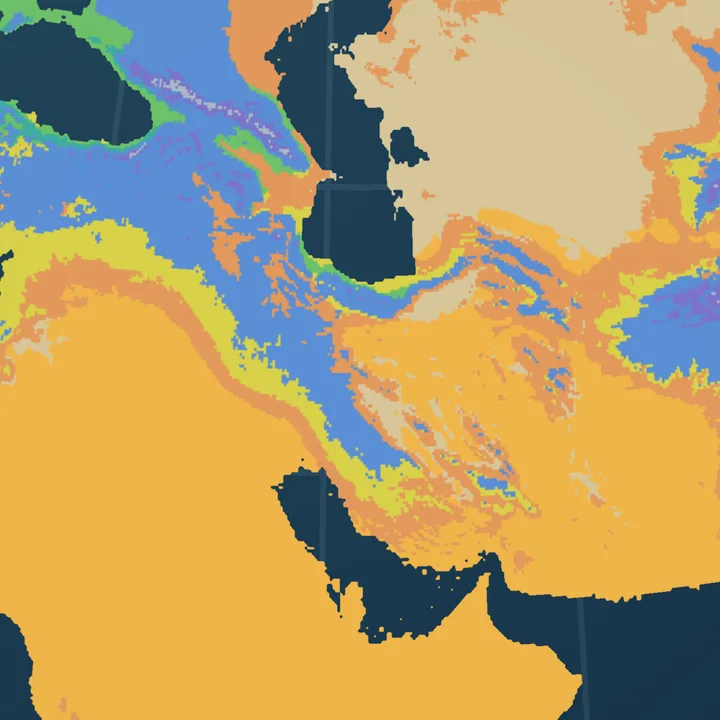
Khuzestan · Iran
Average temperature, rain and snow, sunshine and more for every month in Īẕeh, from modelled 1981–2010 averages for the town itself (about 3 × 3 km around its centre).
Mediterranean, hot summer · CsaOpen Īẕeh on the globe ›Īẕeh is warmest in July, with 42.4 °C (108 °F) days and 25.5 °C nights, and coolest in January, with 11.8 °C (53 °F) days and 0.9 °C nights. Most rain falls around January (181 mm); June is driest (0 mm).
- Day to day
- ±2.7 °Ca typical day’s swing from its month’s normal; most changeable in April (±3.4 °C)
- Year to year
- ±2.0 °Chow much a month’s average varies between years, most in March; least ±0.6 °C in July
- Best months
- Apr, Oct, Novmild and not too wet · where else is warm in April
- Year average20.7 °C69 °F
- Warmest · July34.0 °C93 °F
- Coolest · January6.3 °C43 °F
- Rain and snow a year812 mm32.0 in
- Sunshine a year2,948 habout 1961–1990
Climate type: Mediterranean, hot summer (Köppen Csa) · about this type
Hot, dry summers and mild, wetter winters.
Īẕeh at a glance
Among the 423 towns ClimaClue covers in Iran, Īẕeh is 96th warmest (20.7 °C year average), 180th sunniest (about 2,948 hours of sunshine a year) and 34th wettest (812 mm a year), near the middle on each. Compared with Bāgh-e Malek, the nearest covered town with different numbers (34 km away), Īẕeh is 0.6 °C cooler in July and 0.8 °C cooler in January, with 67 mm more precipitation a year. Its warmest month, July (34.0 °C), averages 27.6 °C more than its coolest, January (6.3 °C). No month has an average night low below 0 °C (32 °F); the coldest, January, averages 0.9 °C (single nights can be colder). The area lies about 169 km from the sea.
Station check: no NOAA GHCN-Daily station with 1981–2010 averages lies within 25 km of Īẕeh, so these modelled values have not been compared with a nearby station.
Temperature and precipitation by month in Īẕeh
Charts: ClimaClue area averages, CHELSA V2.1, 1981–2010. Hover or tap a point or bar for its value; every number is in the table below.
| Month | Average °C | Day high °C | Night low °C | Precipitation mm |
|---|---|---|---|---|
| January | 6.343 °F | 11.853 °F | 0.934 °F | 1817.1 in |
| February | 8.347 °F | 14.258 °F | 2.537 °F | 1315.2 in |
| March | 12.855 °F | 19.066 °F | 6.644 °F | 1345.3 in |
| April | 18.966 °F | 25.678 °F | 12.154 °F | 722.8 in |
| May | 25.979 °F | 33.592 °F | 18.365 °F | 110.4 in |
| June | 31.388 °F | 39.9104 °F | 22.773 °F | 00.0 in |
| July | 34.093 °F | 42.4108 °F | 25.578 °F | 10.0 in |
| August | 33.492 °F | 41.9107 °F | 24.877 °F | 10.0 in |
| September | 29.184 °F | 38.1101 °F | 20.068 °F | 10.0 in |
| October | 22.973 °F | 31.088 °F | 14.758 °F | 140.5 in |
| November | 15.259 °F | 21.971 °F | 8.447 °F | 913.6 in |
| December | 9.249 °F | 14.959 °F | 3.638 °F | 1756.9 in |
| Year | 20.769 °F | 27.882 °F | 13.356 °F | 81232.0 in |
Average: monthly mean air temperature, day and night together. Day high and night low: the month's average daily maximum and minimum (the CHELSA average plus and minus half the day–night range of CRU CL 2.0), not the hottest or coldest days. Precipitation: monthly total of rain and snow as water.
Sunshine, wind and humidity in Īẕeh
| Month | Sunshine hours | Wind m/s | Humidity % | Dew point °C | Fresh snow cm |
|---|---|---|---|---|---|
| January | 172 | 1.43.1 mph | 66 | -0.531 °F | 8.43.3 in |
| February | 183 | 1.43.1 mph | 64 | 0.833 °F | 1.60.6 in |
| March | 212 | 1.43.1 mph | 59 | 3.739 °F | 0 |
| April | 222 | 1.53.4 mph | 49 | 6.644 °F | 0 |
| May | 277 | 1.73.8 mph | 27 | 4.039 °F | 0 |
| June | 325 | 1.73.8 mph | 17 | 1.334 °F | 0 |
| July | 325 | 1.63.6 mph | 17 | 3.939 °F | 0 |
| August | 314 | 1.63.6 mph | 18 | 4.139 °F | 0 |
| September | 295 | 1.63.6 mph | 19 | 1.234 °F | 0 |
| October | 257 | 1.53.4 mph | 30 | 2.436 °F | 0 |
| November | 195 | 1.32.9 mph | 53 | 4.240 °F | 0 |
| December | 170 | 1.32.9 mph | 64 | 1.635 °F | 0.60.2 in |
| Year | 2,948 | 1.53.4 mph | 40 | 2.837 °F | 114.2 in |
Sunshine: estimated hours of bright sunshine (not daylight length or solar energy); the source gives a percentage of possible daylight, converted to hours with astronomical day length; yearly total. Wind: monthly mean speed about 10 m above the ground; gusts and direction are not shown. Humidity: relative humidity, calculated from the month’s average dew point and its average night low and day high (an estimate, not a measurement). Dew point: how much water vapour the air holds. Fresh snow: estimated depth from ERA5-Land snowfall (1 mm of water ≈ 1 cm of snow), adjusted to snowfall measured at nearby weather stations. Year row: totals for sunshine and snow, averages otherwise.
Best time to visit Īẕeh
For mild weather, the best months to visit Īẕeh are April, October and November.
- Mild (average temperature 15–25 °C / 59–77 °F and under 100 mm / 3.9 in of precipitation): April, October and November.
- Warmest (average temperature): July (34.0 °C), August (33.4 °C) and June (31.3 °C).
- Driest (least precipitation): June (0 mm), August (1 mm) and July (1 mm).
- Sunniest (hours of sunshine, about 1961–1990): June (325 h), July (325 h) and August (314 h).
Climate only: these rules use 1981–2010 monthly averages and do not consider crowds, prices, events or holidays; any one year can differ.
Īẕeh weather month by month
Average conditions for each month (1981–2010 monthly averages; sunshine about 1961–1990), not forecasts.
Īẕeh weather in January
Day high 11.8 °C (53 °F) · night low 0.9 °C (34 °F) · average 6.3 °C · precipitation 181 mm (7.1 in) · sunshine about 172 hours · humidity 66% · dew point -0.5 °C · fresh snow about 8.4 cm.
Compared with December: 2.9 °C cooler, 6 mm more precipitation and 2 hours more sunshine.
Īẕeh weather in February
Day high 14.2 °C (58 °F) · night low 2.5 °C (37 °F) · average 8.3 °C · precipitation 131 mm (5.2 in) · sunshine about 183 hours · humidity 64% · dew point 0.8 °C · fresh snow about 1.6 cm.
Compared with January: 2.0 °C warmer, 50 mm less precipitation and 11 hours more sunshine.
Īẕeh weather in March
Day high 19.0 °C (66 °F) · night low 6.6 °C (44 °F) · average 12.8 °C · precipitation 134 mm (5.3 in) · sunshine about 212 hours · humidity 59% · dew point 3.7 °C.
Compared with February: 4.5 °C warmer, 3 mm more precipitation and 28 hours more sunshine.
Īẕeh weather in April
Day high 25.6 °C (78 °F) · night low 12.1 °C (54 °F) · average 18.9 °C · precipitation 72 mm (2.8 in) · sunshine about 222 hours · humidity 49% · dew point 6.6 °C.
Compared with March: 6.0 °C warmer, 62 mm less precipitation and 11 hours more sunshine.
Īẕeh weather in May
Day high 33.5 °C (92 °F) · night low 18.3 °C (65 °F) · average 25.9 °C · precipitation 11 mm (0.4 in) · sunshine about 277 hours · humidity 27% · dew point 4.0 °C.
Compared with April: 7.0 °C warmer, 61 mm less precipitation and 55 hours more sunshine.
Īẕeh weather in June
Day high 39.9 °C (104 °F) · night low 22.7 °C (73 °F) · average 31.3 °C · precipitation 0 mm (0.0 in) · sunshine about 325 hours · humidity 17% · dew point 1.3 °C.
Compared with May: 5.5 °C warmer, 11 mm less precipitation and 48 hours more sunshine.
Īẕeh weather in July
Day high 42.4 °C (108 °F) · night low 25.5 °C (78 °F) · average 34.0 °C · precipitation 1 mm (0.0 in) · sunshine about 325 hours · humidity 17% · dew point 3.9 °C.
Compared with June: 2.6 °C warmer, about the same precipitation and about the same sunshine.
Īẕeh weather in August
Day high 41.9 °C (107 °F) · night low 24.8 °C (77 °F) · average 33.4 °C · precipitation 1 mm (0.0 in) · sunshine about 314 hours · humidity 18% · dew point 4.1 °C.
Compared with July: 0.6 °C cooler, about the same precipitation and 11 hours less sunshine.
Īẕeh weather in September
Day high 38.1 °C (101 °F) · night low 20.0 °C (68 °F) · average 29.1 °C · precipitation 1 mm (0.0 in) · sunshine about 295 hours · humidity 19% · dew point 1.2 °C.
Compared with August: 4.3 °C cooler, about the same precipitation and 19 hours less sunshine.
Īẕeh weather in October
Day high 31.0 °C (88 °F) · night low 14.7 °C (58 °F) · average 22.9 °C · precipitation 14 mm (0.5 in) · sunshine about 257 hours · humidity 30% · dew point 2.4 °C.
Compared with September: 6.2 °C cooler, 13 mm more precipitation and 37 hours less sunshine.
Īẕeh weather in November
Day high 21.9 °C (71 °F) · night low 8.4 °C (47 °F) · average 15.2 °C · precipitation 91 mm (3.6 in) · sunshine about 195 hours · humidity 53% · dew point 4.2 °C.
Compared with October: 7.7 °C cooler, 78 mm more precipitation and 62 hours less sunshine.
Īẕeh weather in December
Day high 14.9 °C (59 °F) · night low 3.6 °C (38 °F) · average 9.2 °C · precipitation 175 mm (6.9 in) · sunshine about 170 hours · humidity 64% · dew point 1.6 °C · fresh snow about 0.6 cm.
Compared with November: 6.0 °C cooler, 84 mm more precipitation and 25 hours less sunshine.
Why Īẕeh has this climate
Typical mechanisms for this climate type, plus facts measured for this place; not a verified local cause.
Summers are warm under persistent high pressure; nearby sea often softens winter cold. In summer the subtropical high pressure moves over and blocks storms, so summers are dry; in winter it retreats and storms from the ocean bring rain. About 169 km from the sea: inland, so ocean moderation is weaker and seasons are usually sharper. Here the coolest and warmest months differ by 27.6 °C.
Strongly seasonal: the wettest month gets more than five times the driest.
Īẕeh climate: questions and answers
- What is the warmest month in Īẕeh?
- July, with an average of 34.0 °C (93 °F), day highs around 42.4 °C (108 °F) and night lows around 25.5 °C (78 °F).
- What is the coldest month in Īẕeh?
- January, with an average of 6.3 °C (43 °F), day highs around 11.8 °C (53 °F) and night lows around 0.9 °C (34 °F).
- Which month gets the most rain in Īẕeh?
- January, with 181 mm (7.1 in) of precipitation (rain and snow as water), out of 812 mm (32.0 in) in a typical year.
- What is the driest month in Īẕeh?
- June, with 0 mm (0.0 in) of precipitation.
- What is the sunniest month in Īẕeh?
- June, with about 325 hours of bright sunshine (estimate for about 1961–1990).
- Does it snow in Īẕeh?
- Yes. About 11 cm (4.2 in) of fresh snow falls in a typical year (ERA5-Land snowfall at 1 mm of water ≈ 1 cm of snow, adjusted to nearby weather stations), most in January; it usually melts within days.
- When is the best time to visit Īẕeh?
- For mild weather (average temperature 15–25 °C / 59–77 °F and under 100 mm / 3.9 in of precipitation): April, October and November. Climate only, from 1981–2010 averages: crowds and prices are not considered.
- What type of climate does Īẕeh have?
- Mediterranean, hot summer (Köppen Csa). Hot, dry summers and mild, wetter winters. Calculated from the town’s own 1981–2010 monthly averages.
Nearby towns in Iran
- Bāgh-e Malek34 km · Csa · 745 mm a year21.6 °C
- Haftkel53 km · BSh · 453 mm a year24.4 °C
- Masjed Soleymān55 km · Csa · 522 mm a year24.9 °C
- Rāmhormoz66 km · BSh · 412 mm a year25.5 °C
- Fārsān81 km · Dsa · 678 mm a year10.0 °C
- Lālī92 km · Csa · 653 mm a year24.0 °C
Compare: Īẕeh vs Kirkuk · Erbil vs Īẕeh
Appears in: Wettest Cities in Iran (#11) · Cities With the Hottest Summers in Iran (#13) · Warmest Cities in Iran (#18)
Climate twins elsewhere
Towns in other countries whose monthly temperature and rain pattern is closest to Īẕeh’s (the measure used by ClimaClue’s Climate Twins game; seasons are lined up across hemispheres).
- Erbil, IraqCsa · months typically 0.7 °C apart
- Cizre, TurkeyCsa · months typically 2.0 °C apart
- Al Ḩasakah, SyriaBSh · months typically 0.9 °C apart
- Chaman, PakistanBSh · months typically 2.0 °C apart
- Kandahār, AfghanistanBSh · months typically 1.7 °C apart
About these numbers
Temperature, precipitation and wind: modelled monthly averages (climate normals) for Īẕeh itself, the average of the ~1 km source cells in the 3 × 3 km around its GeoNames location (31.830°N, 49.868°E). Day highs and night lows add the day–night range of the surrounding CRU cell (about 18 km), or on a few small islands the nearest weather station’s; where there is neither, they are not shown. Sunshine, dew point and snow come from coarser sources and describe the 0.1° area around it, about 9.5 × 11 km (ClimaClue area sq-521-2298), which is also what the globe shows when you click there; humidity is calculated from that dew point and the town’s own night lows and day highs. They are model estimates, not measurements at a weather station, and not forecasts. Sources: CHELSA V2.1, 1981–2010 (temperature, precipitation, wind); ERA5-Land, 1981–2010 (dew point and snow; snowfall matched to the area’s CHELSA climate; contains modified Copernicus Climate Change Service information); relative humidity calculated from the dew point and the night lows and day highs; CRU CL 2.0, about 1961–1990 (sunshine and the day–night range; a different period); GeoNames (name and population 119,399, CC BY 4.0); climate type by the Köppen–Geiger rules of Peel et al. (2007). How ClimaClue makes these numbers.