 ClimaClue
Cities with the smallest temperature swing through the year
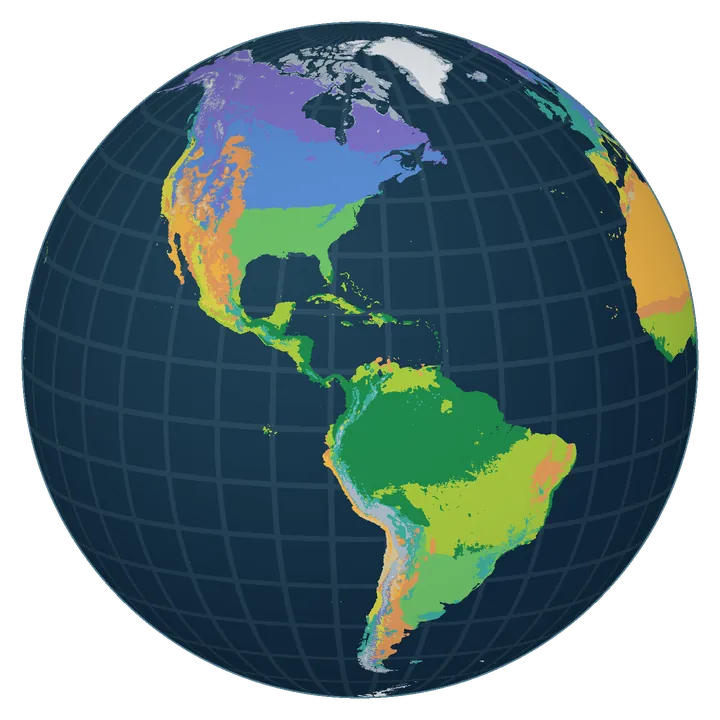
5,180 of the 5,180 towns of 100,000+ people covered by ClimaClue meet this rule: sorted by the difference between the warmest and coldest month’s average temperature (CHELSA, 1981–2010), smallest first.
| # | Town | Warmest − coldest month °C | Warmest month °C | Coolest month °C | Rain and snow mm/yr |
|---|---|---|---|---|---|
| 1 | CartagoValle del Cauca Department, Colombia | 0.5 | 22.472 °F | 21.971 °F | 1,74468.7 in |
| 2 | ManokwariWest Papua, Indonesia | 0.5 | 26.880 °F | 26.379 °F | 2,759108.6 in |
| 3 | ArmeniaQuindío Department, Colombia | 0.5 | 20.168 °F | 19.667 °F | 2,593102.1 in |
| 4 | MedellínAntioquia, Colombia | 0.6 | 20.369 °F | 19.868 °F | 1,76869.6 in |
| 5 | BelloAntioquia, Colombia | 0.6 | 20.669 °F | 20.068 °F | 1,97577.8 in |
| 6 | CajamarcaCajamarca Department, Peru | 0.6 | 13.456 °F | 12.955 °F | 1,37254.0 in |
| 7 | BontangEast Kalimantan, Indonesia | 0.6 | 26.980 °F | 26.479 °F | 1,87273.7 in |
| 8 | PereiraRisaralda Department, Colombia | 0.6 | 19.968 °F | 19.367 °F | 3,310130.3 in |
| 9 | PopayánCauca Department, Colombia | 0.6 | 18.866 °F | 18.265 °F | 2,29490.3 in |
| 10 | ItagüíAntioquia, Colombia | 0.6 | 20.068 °F | 19.467 °F | 2,17585.6 in |
| 11 | JayapuraPapua, Indonesia | 0.6 | 27.081 °F | 26.480 °F | 2,38293.8 in |
| 12 | Loa JananEast Kalimantan, Indonesia | 0.6 | 26.780 °F | 26.179 °F | 2,45896.8 in |
| 13 | SamarindaEast Kalimantan, Indonesia | 0.6 | 26.780 °F | 26.179 °F | 2,42195.3 in |
| 14 | PiedecuestaSantander Department, Colombia | 0.6 | 22.773 °F | 22.172 °F | 1,29551.0 in |
| 15 | Guadalajara de BugaValle del Cauca Department, Colombia | 0.6 | 22.573 °F | 21.971 °F | 1,84372.6 in |
| 16 | TernateNorth Maluku, Indonesia | 0.6 | 26.880 °F | 26.279 °F | 3,051120.1 in |
| 17 | TuluáValle del Cauca Department, Colombia | 0.6 | 22.472 °F | 21.871 °F | 1,76569.5 in |
| 18 | MusanzeNorthern Province, Rwanda | 0.6 | 18.165 °F | 17.463 °F | 1,40155.2 in |
| 19 | PaluCentral Sulawesi, Indonesia | 0.7 | 26.980 °F | 26.379 °F | 1,07142.2 in |
| 20 | BitungNorth Sulawesi, Indonesia | 0.7 | 27.181 °F | 26.480 °F | 2,53099.6 in |
By continent: Asia 2,681 · Africa 770 · Europe 677 · South America 552 · North America 472 · Oceania 28.
Among the 5,180 towns of 100,000+ people covered worldwide; not a complete list of every city. Left out: towns in 10 km areas where a nearby weather station’s 1981–2010 averages disagreed with the modelled values; towns sharing a 10 km area with a larger town are counted once.
Values are modelled averages for each town’s own location (the ~3 km around its centre; sunshine, dew point and snow: the ~10 km area around it), not station measurements; ranking is a plain sort of the stored values (ties: larger town first).
Climate types: Tropical rainforest (Af) · Tropical monsoon (Am) · Tropical savanna (Aw) · Hot semi-arid (BSh) · Cold semi-arid (BSk) · Hot desert (BWh) · Cold desert (BWk) · Humid subtropical (Cfa) · Oceanic (Cfb) · Subpolar oceanic (Cfc) · Mediterranean, hot summer (Csa) · Mediterranean, warm summer (Csb) · Humid subtropical, dry winter (Cwa) · Subtropical highland, dry winter (Cwb) · Subpolar highland, dry winter (Cwc) · Humid continental, hot summer (Dfa) · Humid continental, warm summer (Dfb) · Subarctic (Dfc) · Very cold subarctic (Dfd) · Continental, hot dry summer (Dsa) · Continental, warm dry summer (Dsb) · Continental, hot summer, dry winter (Dwa) · Continental, warm summer, dry winter (Dwb) · Subarctic, dry winter (Dwc) · Tundra (ET)
Related: Cities that are mild all year · Cities with no winter · Cities with the biggest day-night temperature swing · world rankings · all themes
Sources: CHELSA V2.1 (1981–2010; temperature, precipitation, wind), ERA5-Land (Copernicus, 1981–2010; dew point, snow; contains modified Copernicus Climate Change Service information), relative humidity calculated from that dew point and the CHELSA night lows and day highs, CRU CL 2.0 (New et al. 2002, about 1961–1990; sunshine and the day–night range), NOAA GHCN-Daily (station normals 1981–2010; temperatures and snowfall adjusted toward nearby stations), GeoNames (town names, populations and heights, CC BY 4.0), climate types by the Köppen–Geiger rules of Peel et al. (2007).